Category Archives: Travel

Boten, Laos to Luang Prabang, Laos

3/24 – the story continues from previous post, 15 hours into our bus ride:

We walked into the golden stupa at Boten, which welcomed us to Laos.  We had to fill out forms and purchase visas here, which was no trouble.  Bring a passport photo, and the equivalent of $35.00.  Other blogs indicated that we would have to pay in US dollars, but we had no trouble paying in yuan.  We then had to stand in line to get through Customs.

When we emerged, I couldn’t see anyone else from our bus, but we could still see the big blue bus on the line of vehicles going through the border crossing.  There were plenty of people standing around, so we stood too.  After a while, the bus to Ventiane that had been behind us pulled up, and most of the people started getting on.  A taxi driver approached us and tried to usher us into his taxi.  No, no, we said, we don’t need a taxi.  We’re waiting for our bus.  With little English, he indicated we should get in his taxi to get to our bus.  Now I was worried.  Where were the other people from our bus?  We walked back across the border, and the big blue thing we mistook for our bus was actually a big blue truck.  Oh no!  The bus left without us!

We went back to where the people were boarding the other bus.  One man had a phone, and called someone, and handed me the phone.  A female, in stilted English, said our bus was 8 kilometers down the road, and we had to take a taxi to catch up.  That explains the insistence of the taxi driver – our bus driver must have sent him when he realized we were not on board.  But where was he now?  When we refused to get in his taxi, he had gone.  We were stranded!  We looked up and down the street, but there were no other taxis to be found.  Then the Ventiane bus pulled up and opened its doors.  The driver indicated that we could hop on.  He would take us to our bus!  We sat on the front step for a 10 minute ride down the road, and breathed a sigh of relief when we spotted Big Blue in front of a thatch covered eatery.  We thanked the driver and ran back to our bus, where our driver was looking a little worried.  We agreed not to let the bus out of our sight again!image


We got something to eat, although my stomach was in a knot, and got back on the bus.  Now that it was daytime, I wished I could sit up, but lying in my bunk was really the only option.  Tried to take some pix out the window, with limited success.image image


We are definitely not in China anymore.  We pass little villages with thatched roof shacks, and children playing in the dirt. Note that the huts are equipped with satellite dishes.image image

We see wild pigs, a water buffalo, goats and chickens in the street.  When the bus stops for a break, the men pee over the cliff on one side, while we women squat behind a big rock on the other.  The road is so narrow that only one vehicle can pass at a time, so we stop whenever there is oncoming traffic.  It’s slow going, and very bumpy where the road is not paved. We read that during the wet season, buses cannot complete this journey. It’s a gray day, and I hope it’s not going to rain!

By mid afternoon, we are stopped more than we are moving. The road is being paved, and we get to watch whole families working at the roadside.image

Somehow, the afternoon passes, and now it is dark. As we approach our destination, the driver stops whenever we get near where someone lives, and he has to get out to retrieve their baggage from the storage area. Then we pass some restaurants, and the bus stops to deliver boxes of supplies. At 9:30pm, 27 hours after we boarded, we finally pull into Luang Prabang. I’m so tired I can hardly see. A Chinese couple from the bus ask if they can share a tuk-tuk with us, and we all pile in. The night air is warm, and there are flowers everywhere. Our guest house is right in the middle of town, and we register and tumble gratefully into a hot shower and a soft bed. We’re here!

Kunming, China to the Laotian Border

3/23 – Today is our last day in China, and we have some errands to run.  Most important, Jim has to find some more Lipitor.  We’ve had no trouble refilling his prescription in Europe, Türkiye, and the former Soviet countries, but this medicine is prohibitively expensive in China.  Jim’s research indicates that cholesterol medicine is not something widely prescribed here.  After trying several pharmacies, we walked into a hospital and tried the pharmacy there.  They had the generic equivalent of Zocor, a similar drug, so we purchased a month’s worth, standing on three different lines to get registered in the system, pay up front, then collect the pills.  Bureaucracy aside, we probably got them faster then waiting for a pickup at Walgreens, and without a word of language…

We ate lunch, packed up and left our hotel by 3pm, to take the Metro to the South Coach Station for our bus to Laos.  The Metro is brand-sparkly new, with attendants to help you purchase tickets from automated machines, and attendants to help you board the train. This photo courtesy of Google. image
You wait for your train behind a wall with sliding glass doors that don’t open until the train arrives, so no one can accidentally fall onto the tracks. image
The stations are announced both in Chinese and English.  The cars weren’t packed full.  It was a great experience!
Kunming recently built four bus stations located at the four compass points of the city, to spread out the traffic jams that used to occur at the central bus station. If you are traveling south, your bus leaves from the South station. So logical!  Here is Jim waiting for our bus to arrive.image

We boarded our overnight sleeper bus at 6pm for the 400 mile, 24 hour trip south across the Chinese border at Mohan to Luang Prabang, Laos. Some of the buses looked new and posh, but ours looked like it had seen better days, and lots of mud.image

The bus has three rows of double-decker bunks running head-to-toe, and an area in the back where it looks like lots of people are just crammed together.  No toilet on board, but we understand that the bus will stop every few hours.image

Jim and I have bunks on the left aisle, so we can see out the window.  The folks in the middle aren’t so lucky.  We’ve been issued blankets and pillows covered with light blue flannel sheets featuring Snoopy (spelled Snopy – in China, close is good enough…) and Woodstock – this is going to be just like a fun sleepover!  At 5’6″, I fit comfortably in my bunk, with my feet touching the board at Jim’s head.  At 6’3″, Jim looks like a pretzel.  One of our fellow passengers pantomimed that Jim would be better off stretching out on the floor!  Before too long, the rocking of the bus lulled us to sleep.
3/24 – at 2am, the bus stopped, and stayed stopped until 5am.  What’s the use of an all night bus if it’s not going to drive all night?  We’ll never know.  Today is Jim’s birthday.  He said there is no way he would rather spend his day…
At 10am we reached the border at Mohan, and officially left China, then walked up to the golden stupa that welcomed us to Laos.

image

This epic saga continues in the next post!

Kunming – the Golden Temple

3/22 – So far, we have visited several Buddhist temples.  Today we are going to a Taoist temple, on the outskirts of the city, a half hour’s taxi ride away.

The Golden Temple is located at the top of Singing Phoenix Hill, and is home of the Taoist Hall of Supreme Harmony.  It was originally built in 1602, and has been moved and rebuilt several times.  In the late 1800s, it was rebuilt using 250 tons of bronze, which shines like gold, hence the name Golden Temple.
The temple is at the top of the hill, and is reached by climbing a series of marble staircases.  Up, up, and up some more!  There’s a lift that looks like a roller coaster car for those who don’t wish to tackle all the steps.  Lots of souvenir and snack stands, and one very photogenic camel, who turned to face whoever wanted to snap a picture of him (her?).IMG_8243 

The hill is famous for its camellia and azalea gardens, and we got to see the last of the Japonicas in bloom.

image

Also, a lovely arbor of lilacs.image

Some folks practiced their music, while others listened.image

There were tranquil ponds, and a statue of Kwan Yin, Goddess of Mercy.imageimage

We climbed the bell tower, where folks queued up to ring the bell for luck.image

From the tower, we looked out over the smoggy city.imageimage

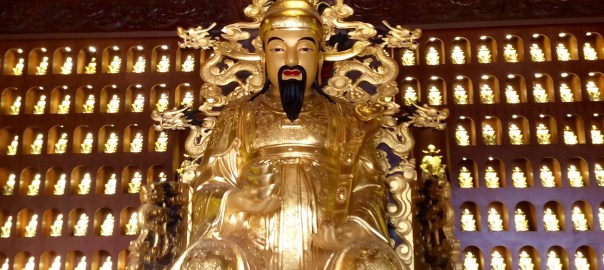
The main temple featured a bronze statue of Taoist hero God Zishi.image

Not sure who this guy is…image

A peaceful, lovely day.image

image

Kunming – Golden Horse, Jade Rooster, Green Lake

3/19 – Today we ventured out to find some sights that looked to be within walking distance from our hotel.  Remember when we used to walk everywhere?  Since we’ve been in China we’ve been forced to take taxis due to the hugeness of the cities, our inability to read the street signs, and the lack of Google Maps on my phone.  It’s a beautiful spring day – remember, Kunming is the city where it’s always spring- and it was nice to walk for a change.

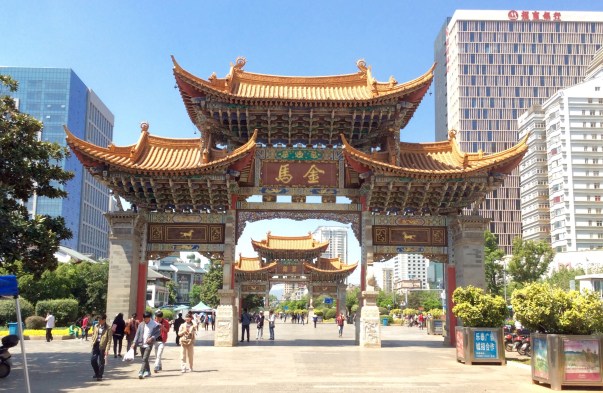
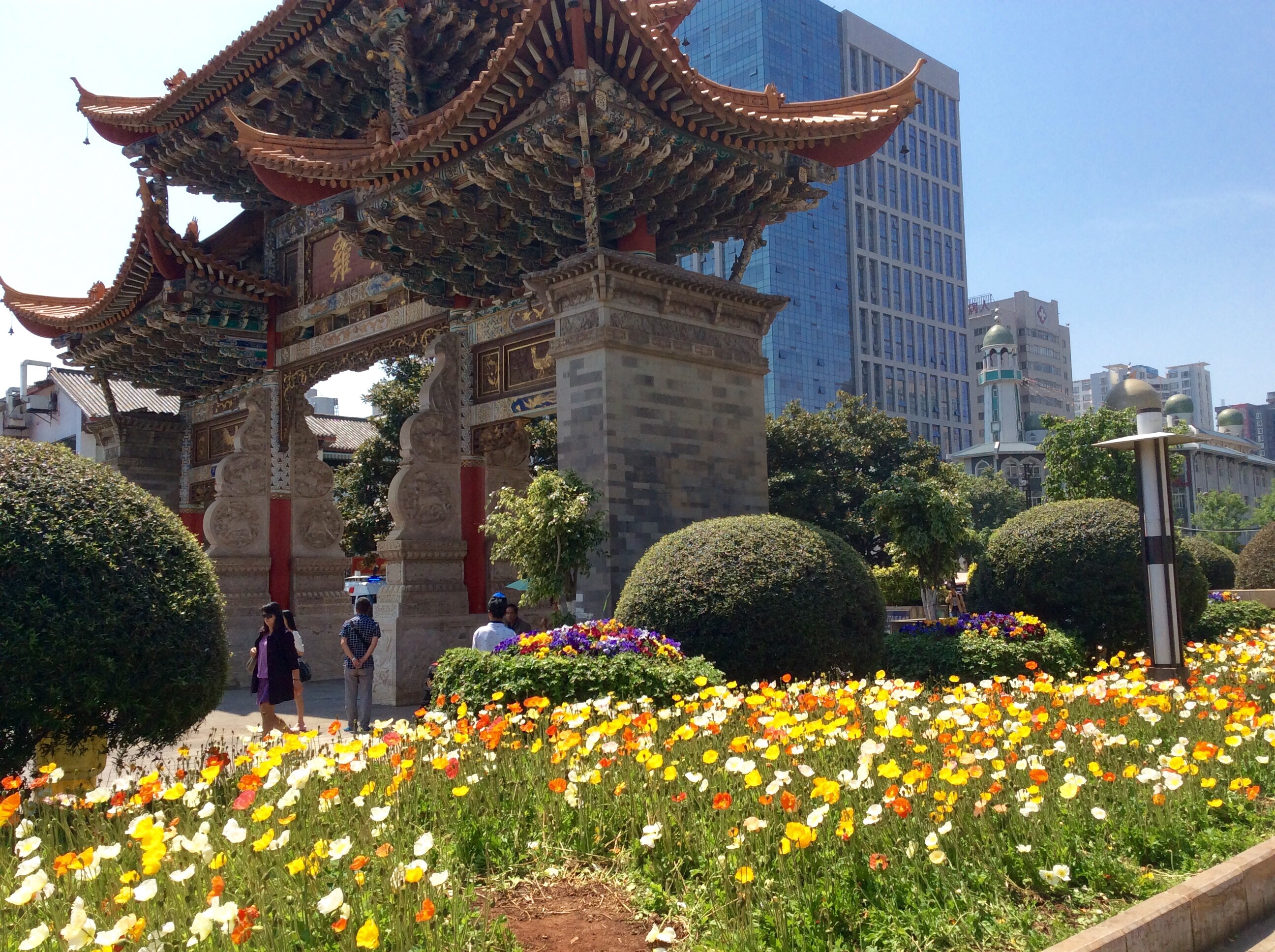
Our first goal was the Golden Horse and Jade Rooster Arches, which are the symbol of Kunming.  Over 400 years old, they stand side by side, representing the center of the old city.   The Golden Horse is in the foreground, and the Jade Rooster is beyond.

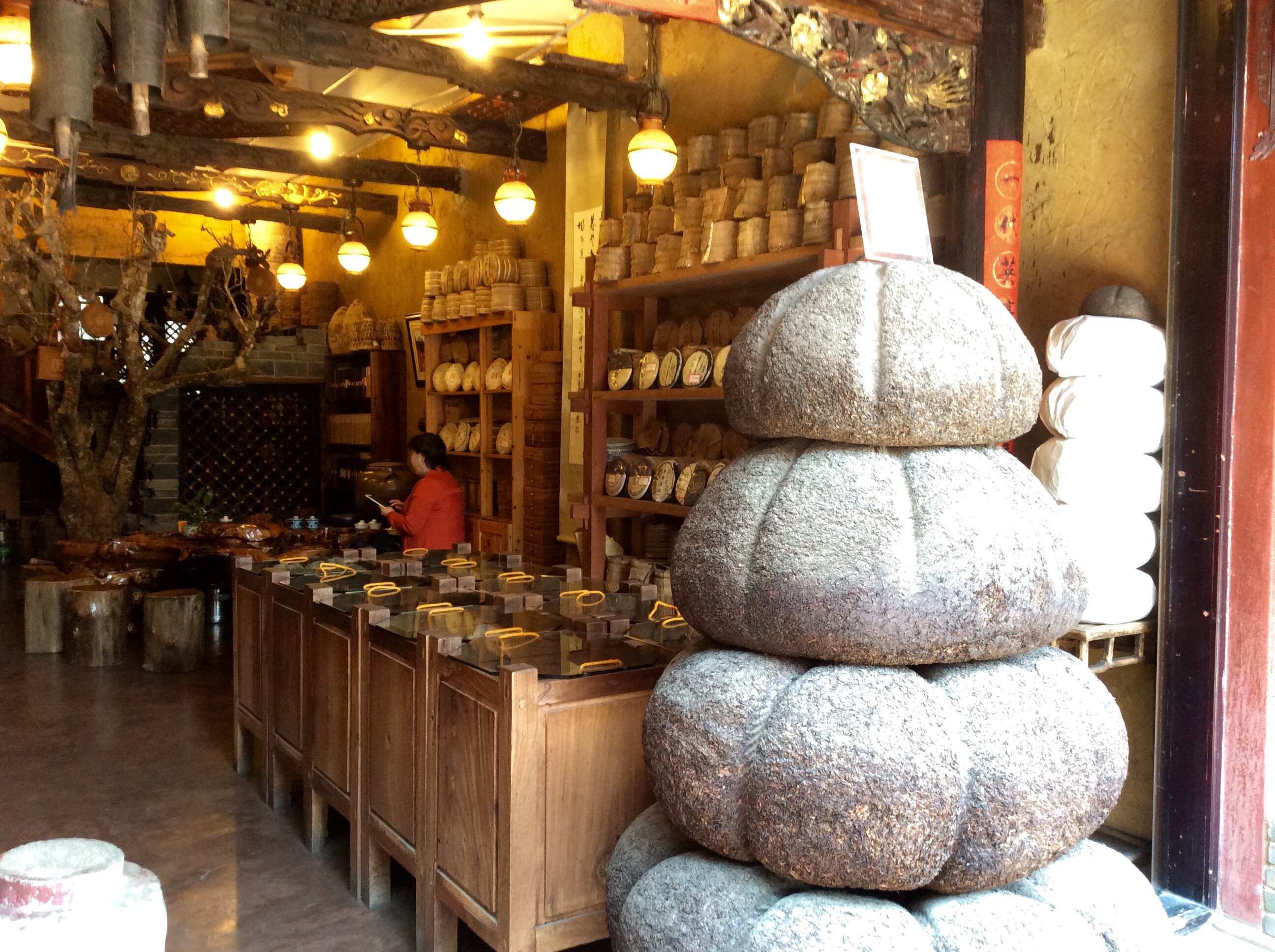
The arches are now surrounded by upscale stores and souvenir shops.   This shop sells compressed wheels of tea. Yes, that is a mountain of tea in the foreground.IMG_8203


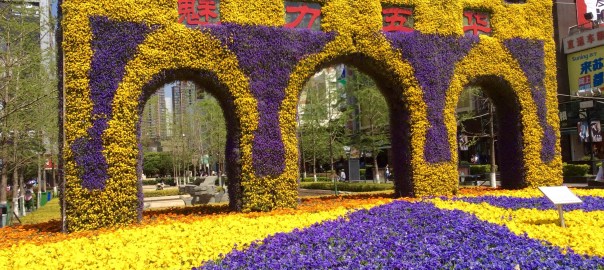
Lots of pretty flowers.image
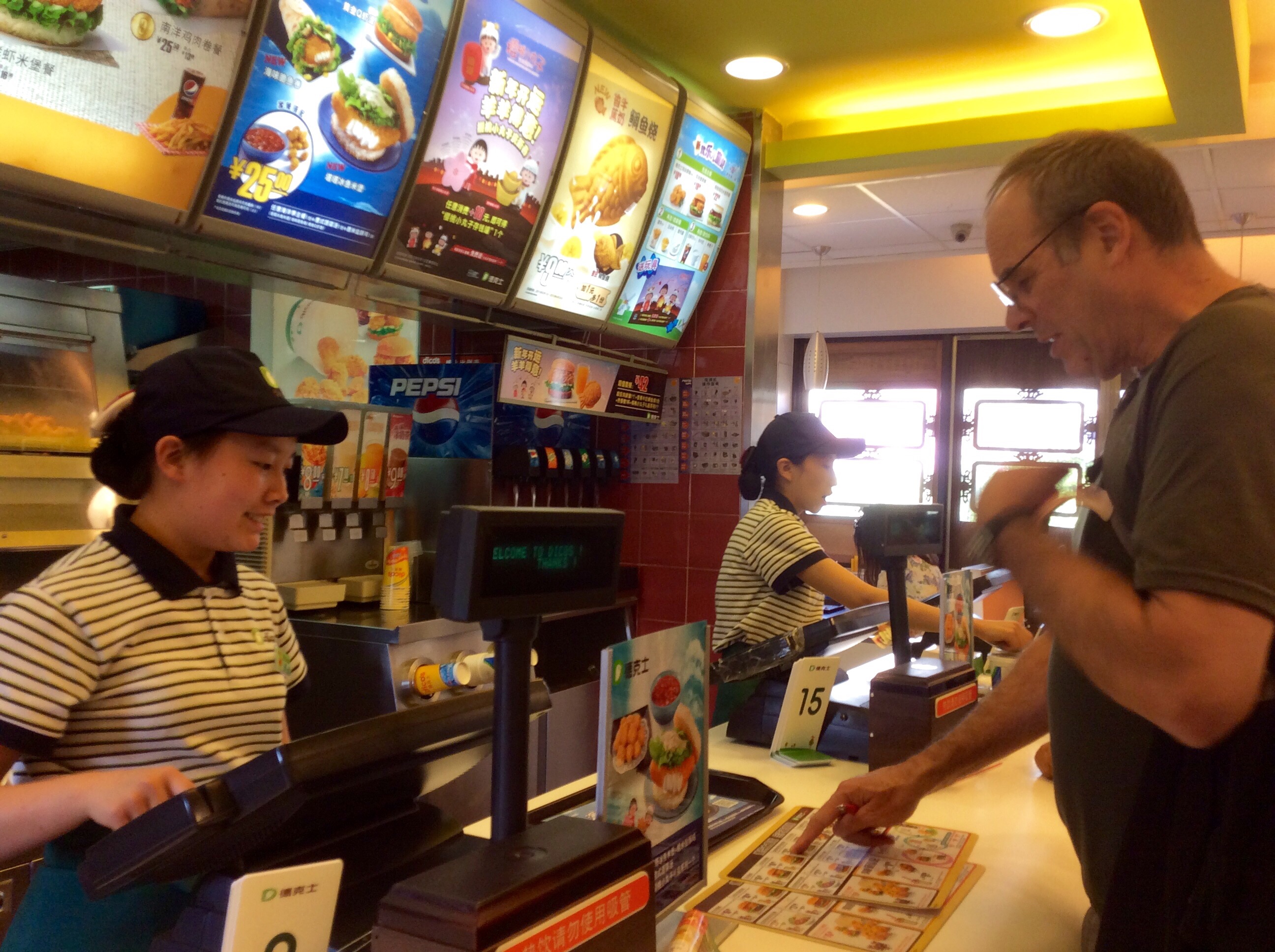
We stopped for lunch at Dicos, a fast food seller of chicken and fish sandwiches that we have seen in several cities, but have not tried.  Jim is a master of pantomime ordering.  Chicken- thumbs up, fries- not so good.  And don’t ask for extra ketchup…

image

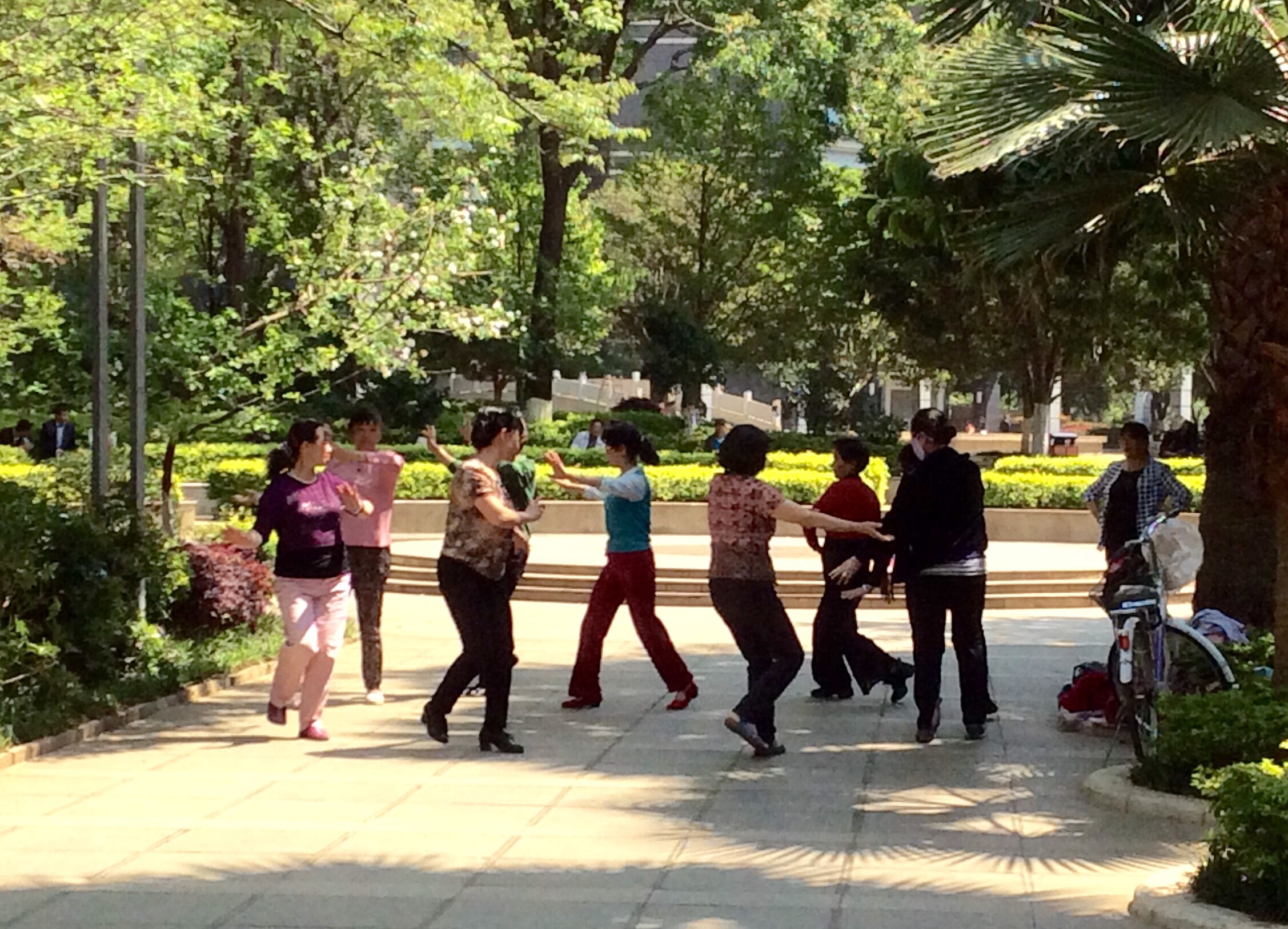
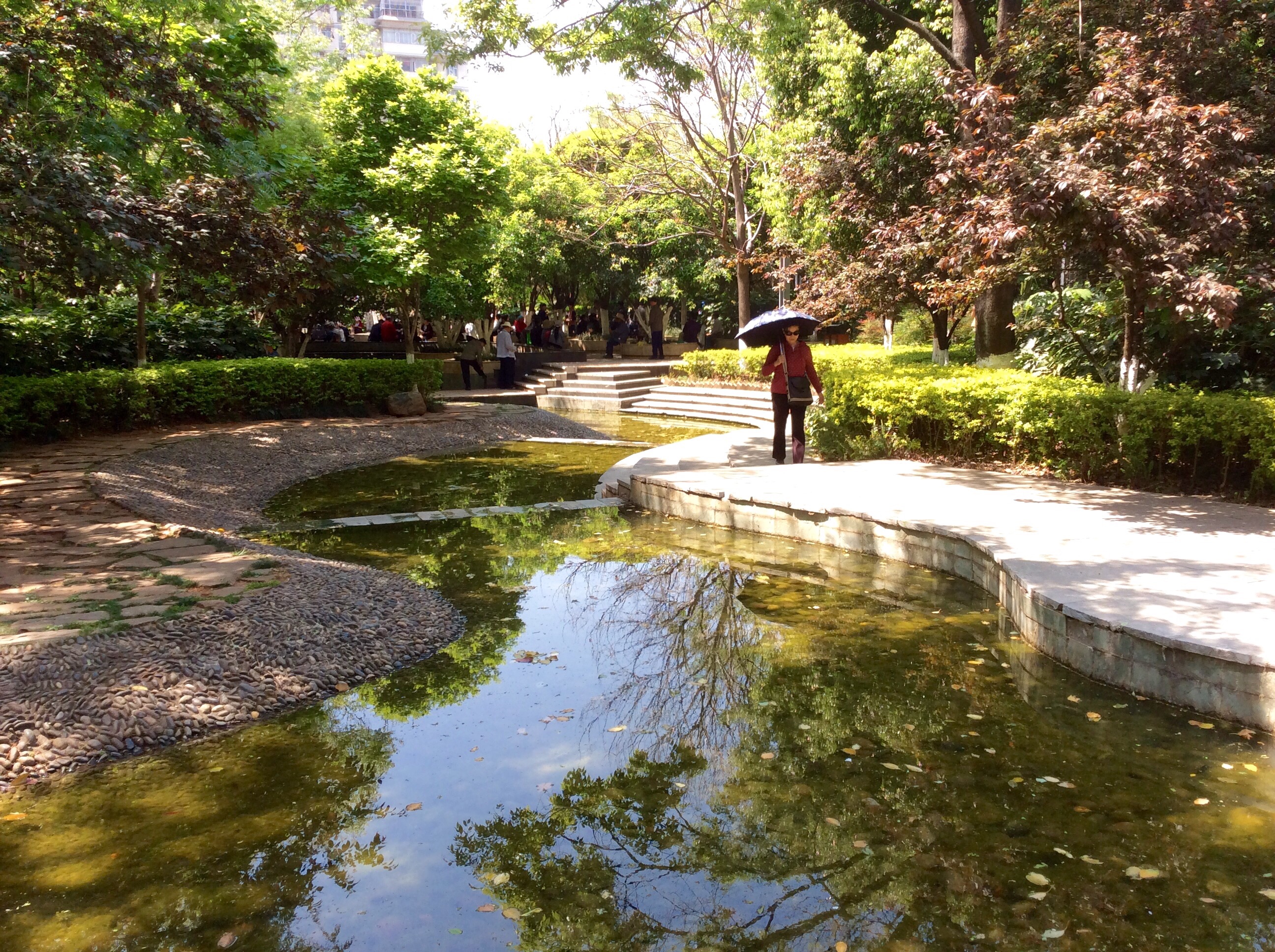
In the afternoon, we set out to find Green Lake Park, a huge park right in the center of the city.  We found a neighborhood park, with men playing checkers and women practicing their line dancing.
image image

Now that the weather is warm, we see many women here shading themselves with parasols, or shielding their faces and necks from the sun with face mask contraptions.  Fairness of complexion is highly prized here, and the makeup commercials tout making one’s skin lighter.image

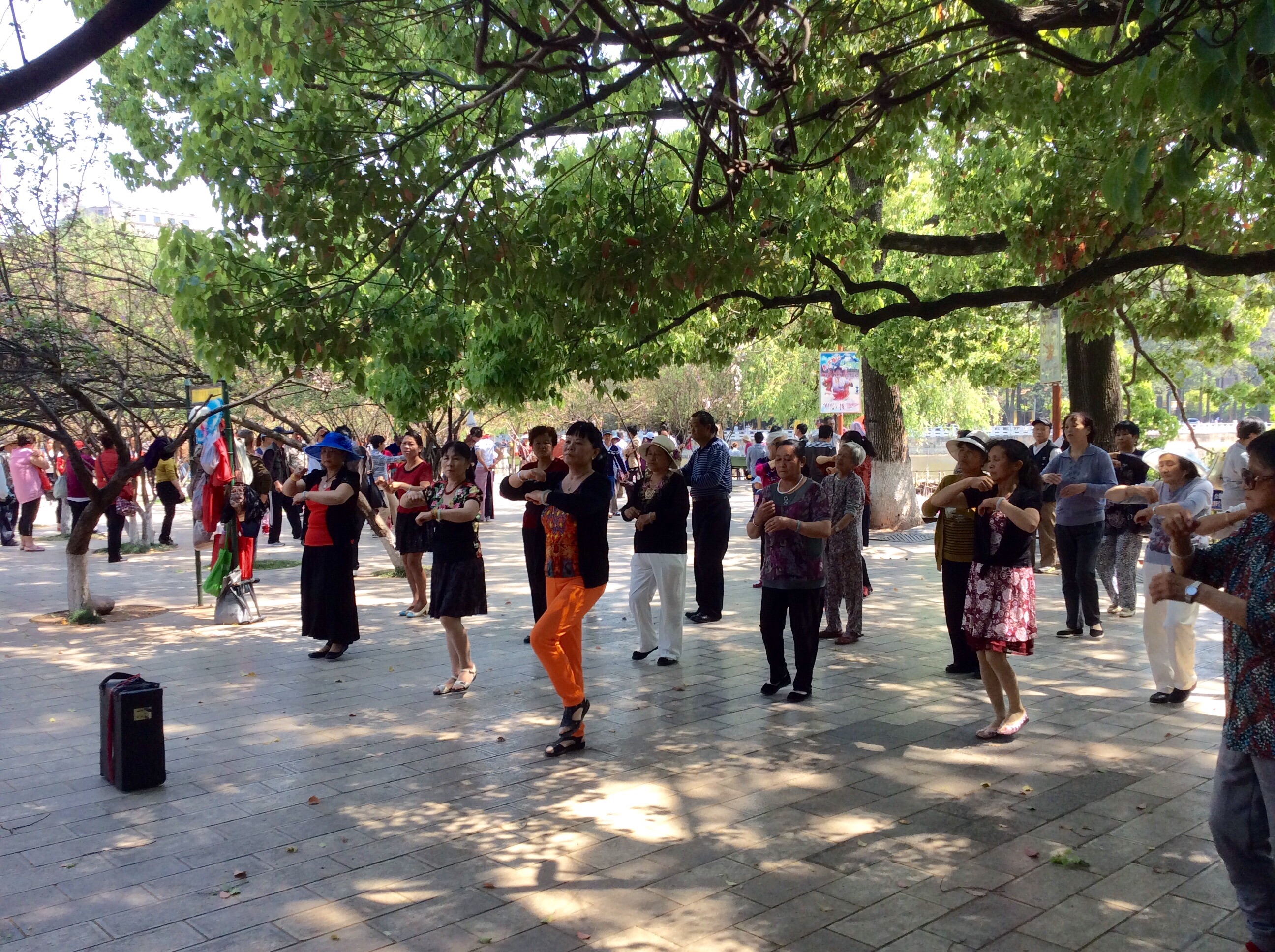
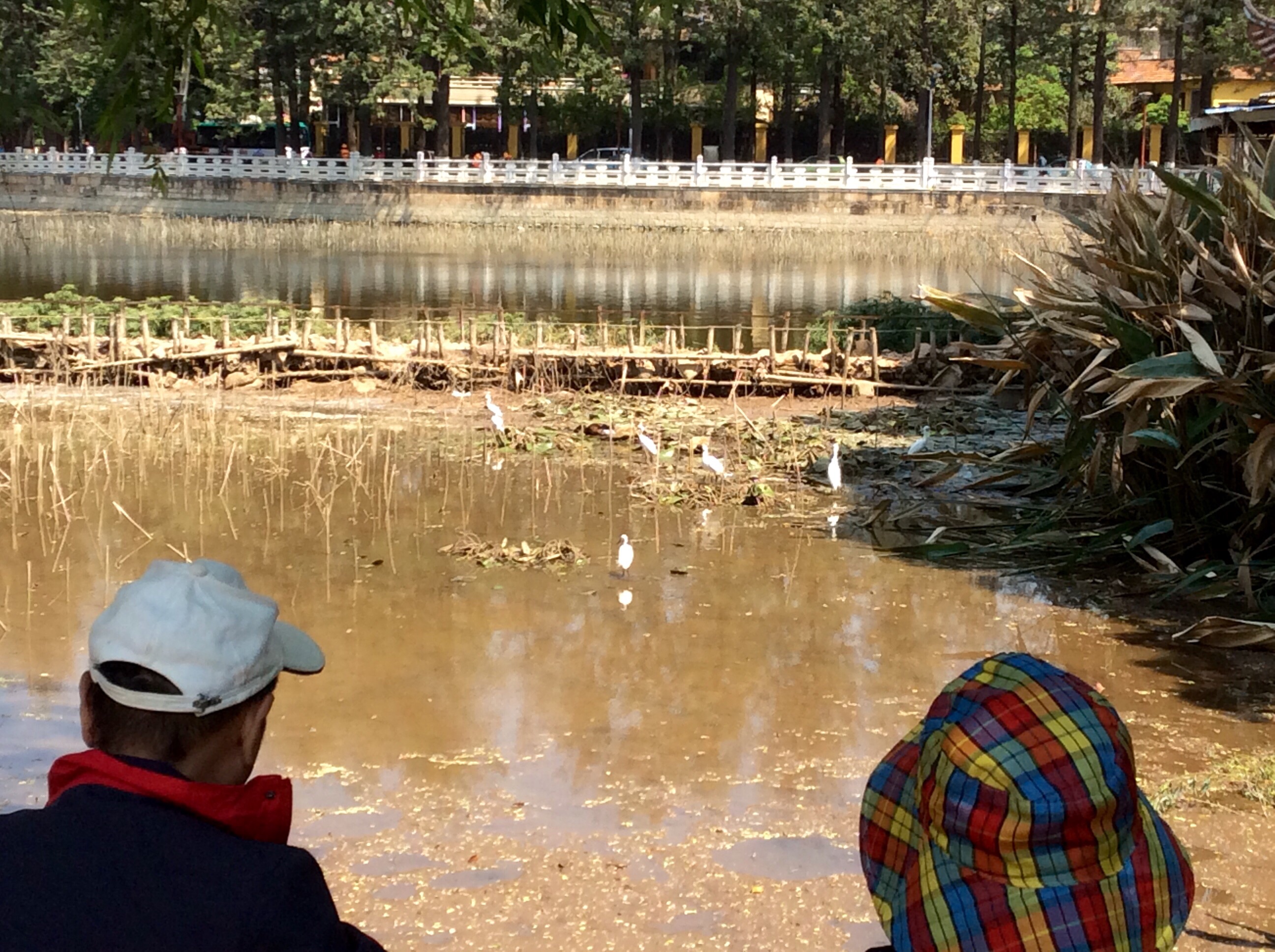
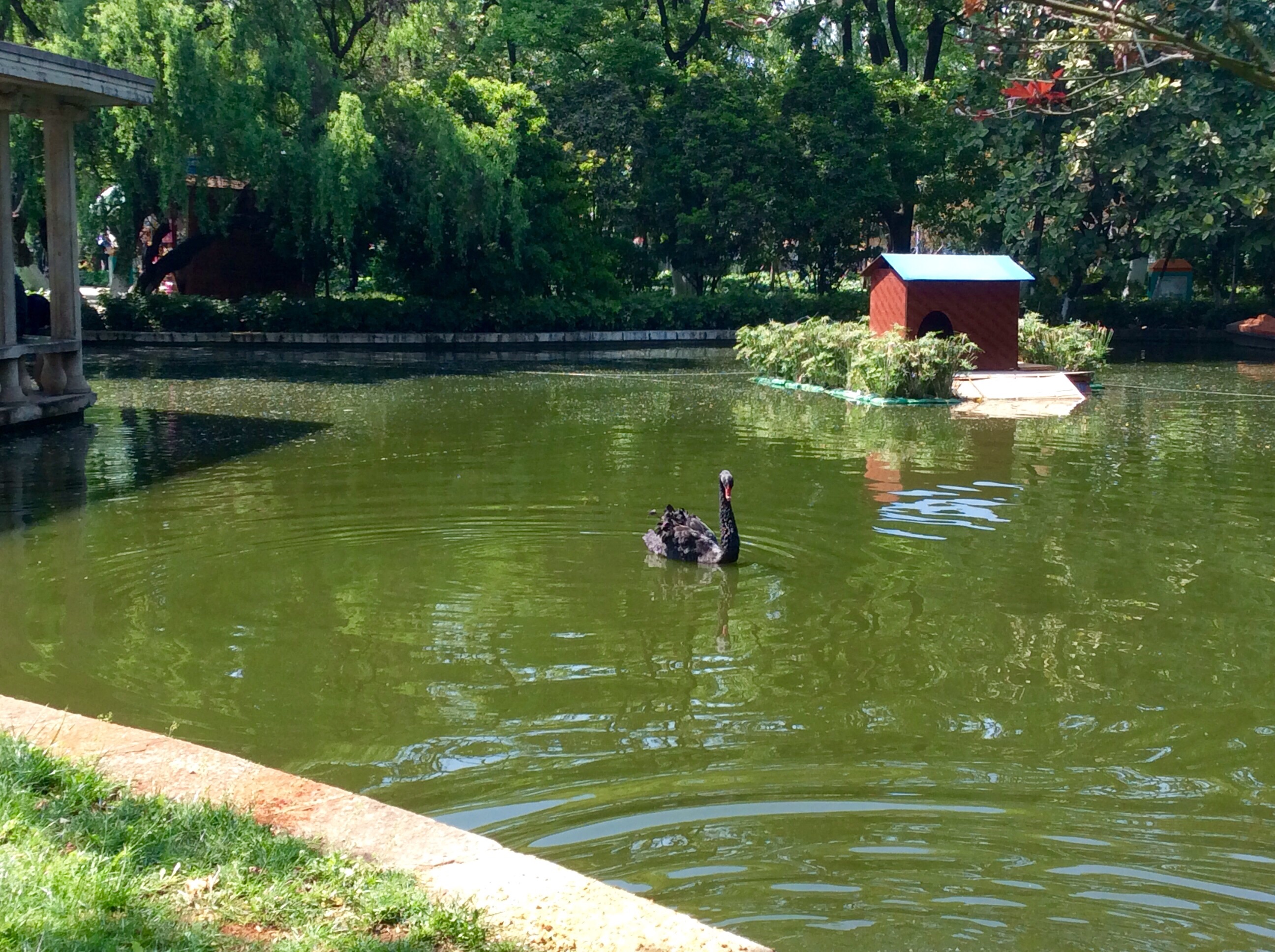
After asking a few more times, we found Green Lake Park. It was, indeed, huge, and had at least ten groups practicing their line or circle dancing, cranking up their boom boxes to outshout one another. See the New York Times article on the Chinese government’s plans to regulate the Dancing Grannies here. http://sinosphere.blogs.nytimes.com/2015/03/24/china-seeks-to-impose-its-own-routine-on-public-dancing/?emc=edit_ee_20150325&nl=todaysheadlines&nlid=68623949&_r=1.imagePacked with people and snack stalls, we strolled around, admiring the egrets and the black swans on the lakes. A lovely afternoon.
image
image


Chengdu to Kunming, China

3/17 – There was nothing else we wanted to see in Chengdu, so we are continuing south to Kunming.  We enjoyed a leisurely morning, as our train doesn’t depart until 15:00 this afternoon. Same hotel breakfast ( I skipped the pickled cabbage and had an extra egg), and an especially good lunch of dumpling soup with leeks and chives.  Jim had a spicier dish comprised mainly of chicken skins.  

We gave ourselves an hour to complete the 10 minute ride to the train station, so, of course, circumstances conspired against us. Background:  hotels in China ask for a cash deposit when you check in, then send a maid up to inventory the room when you check out, to make sure you haven’t stolen anything.  Some hotels have items for sale in the room – razors, decks of cards, cans of soda, beer, and snacks – clearly marked.  Most hotels provide an electric kettle and teacups, bottled water and a variety of tea, gratis.  When we tried to check out of this hotel, we were presented a bill for 40 yuan for the sundries we had used – the tea, the tissues, the bottled water, and what we thought was a complimentary toothbrush.  After almost a month in China, this is the first time we have encountered this.  They also claimed we stole a towel, which others online had reported was a common ploy to extract more money from tourists here.  I shouted and waved my good arm around, gave back the toothbrush and got the damage reduced to 15 yuan ($2.42), but it cost us 15 minutes in the lobby.
We hustled down to the main road, (Jim still lugging both our packs) but had a hard time getting a taxi to stop, and when we finally did, the traffic was bumper-to-bumper all the way to the train station.  Passing through Security, I got pulled over because my passport number was not correct on the train ticket.  The young woman showed me the discrepancy and I just shrugged.  I didn’t type up the ticket – I didn’t even know they were putting our passport numbers on there!  We had to march over to the supervisor, who examined my passport and Chinese visa very carefully and then let us through.  We got to our gate just as our train was being called. Whew!
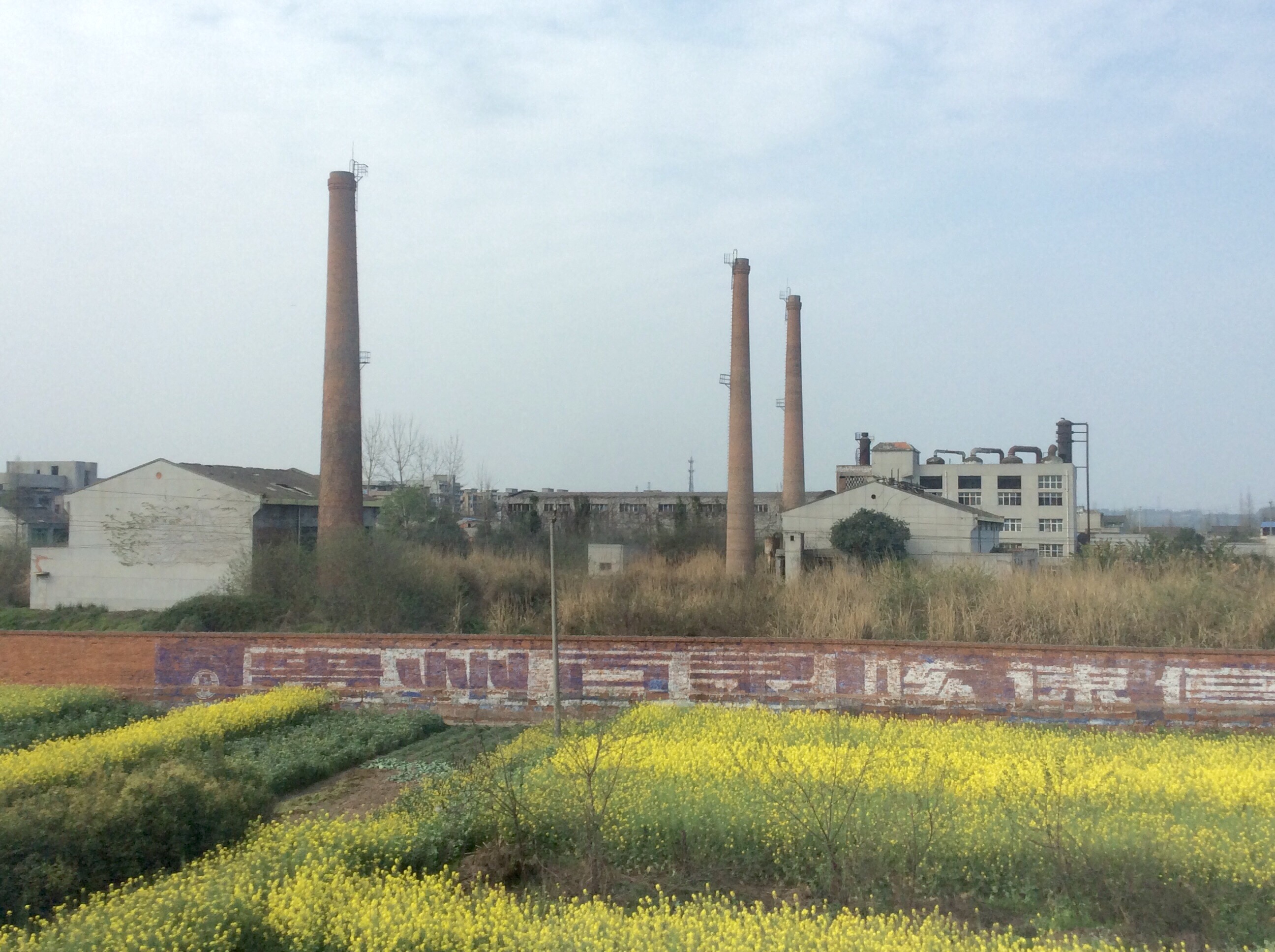
So now we are on the overnight sleeper to Kunming, in our comfy lower bunks of a soft sleeper with a door that closes, fresh linens (I presume), and a young man and a young woman texting away on their mobiles on the berths above.  The afternoon is warm (mid 70s) and we can actually see the sun as we leave the city.  Here are some views out the train window.

IMG_8183IMG_8182

3/18 – After a bumpy night’s sleep, we arrived in Kunming at 9 am.  The train station is huge, and we have to walk quite a way before we can find a taxi.  Kunming is called Spring City in China, as the weather is always perfect – not too hot and not too cold.  It is a favorite destination for Chinese tourists.  Although there is some smog, the sky is definitely blue!
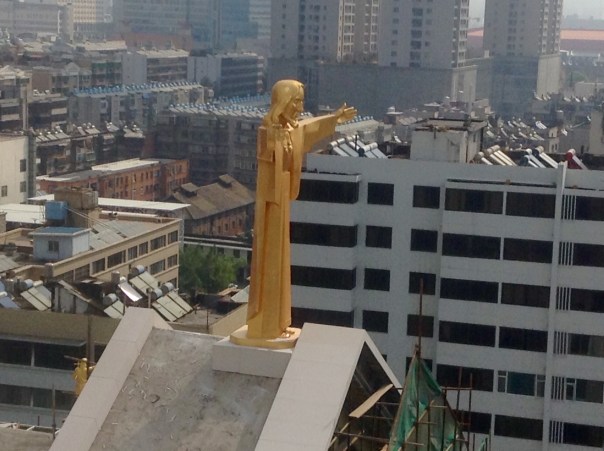
Jim booked us at a new hotel in the center of the city, which does not appear on any of our maps.  The only clue I have is that one of the exterior pictures of the hotel on the Booking.com website shows a large golden statue of Jesus.  Can’t be too many of those in the middle of Kunming!  Sure enough, we spot the statue, and identify the tall building that must contain our hotel.  It is an insurance company building, in the middle of a construction zone, but we know our hotel is on the 8th floor.  We’re getting pretty good at sleuthing our way around without being able to read the language. 
 

In the afternoon we checked out the options in our neighborhood – fruit shop, plenty of noodle eateries (not big enough to be called restaurants, just a few tables) of the kind we favor, but no market, super or otherwise, which is too bad, as our hotel room has a fridge and a microwave.
We has supper at a nearby eatery that provided a delicious full meal including soup, tea, two vegetables, a meat entree and rice for 15 yuan ($2.42). The proprietor came over after observing me eating with my chopsticks in my left hand, and tried to get me to take a new pair of chopsticks with my right hand.  I thanked her, but was puzzled.  I wonder if I am offending by using my left hand – I know I would be in India, but this is the first time I’ve been approached here.  She could see the sling on my right arm – this was one of the many times a bit more knowledge of the language would have helped!

Xi’an to Chengdu, China

3/15 – Neither of us got much sleep last night, waiting for the alarm to go off at 5am so we could walk back to the station for our early train. Today we ride 14 hours south to Chengdu.

Unfortunately, according to my research last night, we will not be leaving the pollution behind in Xi’an. We both have headaches, coughs and nasal issues from the smog, and are considering whether to keep trying to find a cleaner place in China, or to just get out of the country. We’re leaning toward the latter.

The crazy thing is these folks don’t think they’re doing enough damage just breathing – they smoke like chimneys. In the elevator, on the train, in restaurants – no smoking signs are displayed and ignored. While I’m ranting, I’ll tell you something even worse – it seems to be perfectly acceptable here in China to hawk and spit. Loudly. All the time, on the street, indoors, into a trashcan. So gross. Watch where you step.

And while I’m at it, toddlers don’t wear diapers here – their pants have little cutouts so they can squat and poop right on the sidewalk. Although their little tushes are cute, still gross. I think I may be over China…  End of rant – sorry!

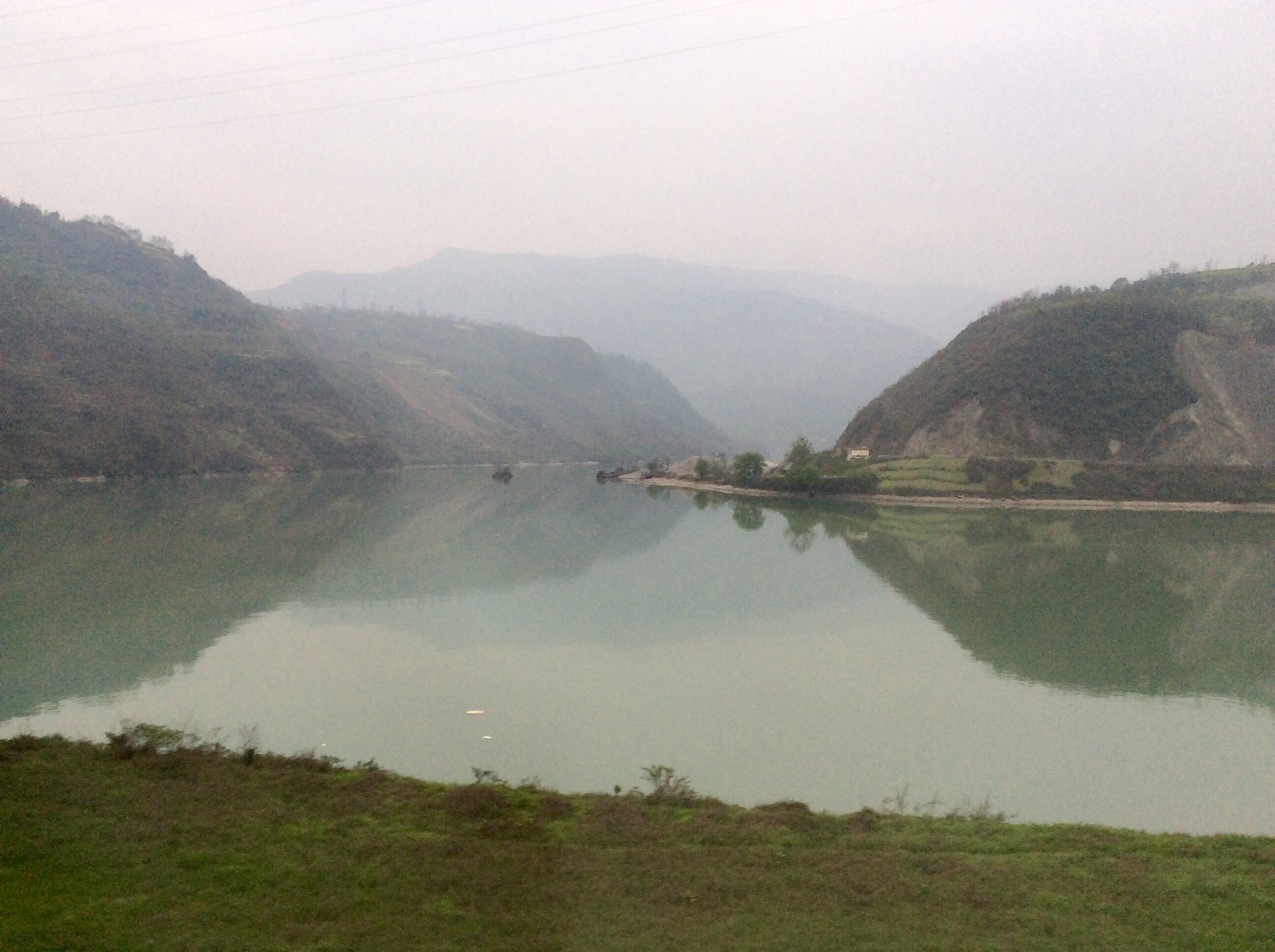
We had hard sleeper berths on the train. Jim had a middle and I had a lower berth in the six berth compartment. All full. The lights were still out when we got on the train, and we had to ask for help finding the right berth. Much to my dismay, both our berths had already been slept in and recently vacated. No new linens for us. I sat up for an hour, then succumbed to the lure of the pillow, and laid down to catch up on the sleep I had missed last night. Here is a view out the window when I awoke. I believe the yellow is rape, used in making rape seed oil.image

Chengdu was the last stop at 8:40pm, and everybody got off the train. A short taxi ride, and now we are at our hotel, where some drunken teenagers accosted Jim and let him know he was the tallest person they had ever seen. Sigh. These people need to get out more.

3/16 – A good night’s rest, and a typical Chinese breakfast – spicy Szechuan carrots and pickled cabbage, eggs hard boiled in soy sauce and sweet peanuts. Rolls that looked like marshmallows and tasted like air. No coffee or tea in the mornings, but warm milk.

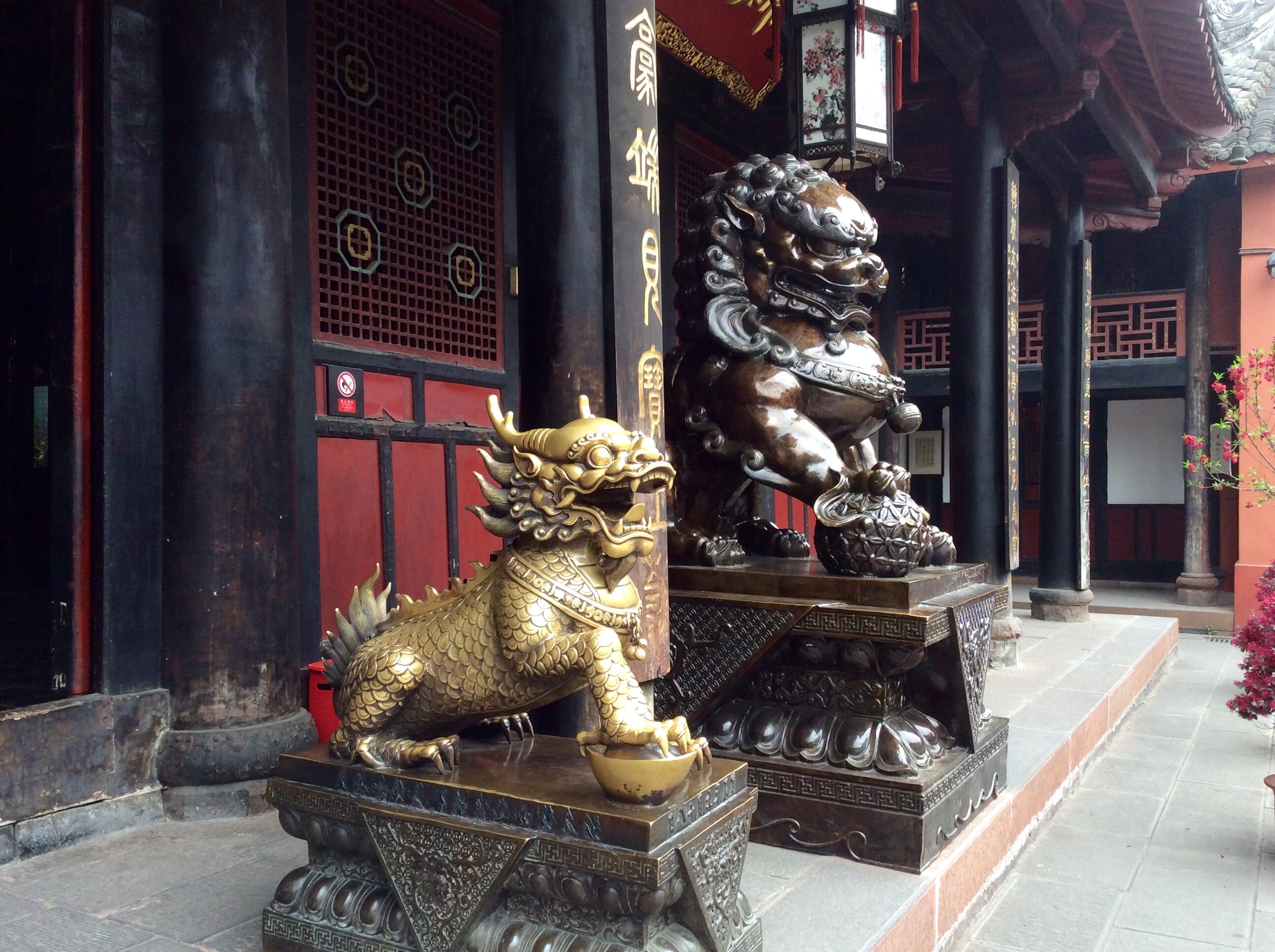
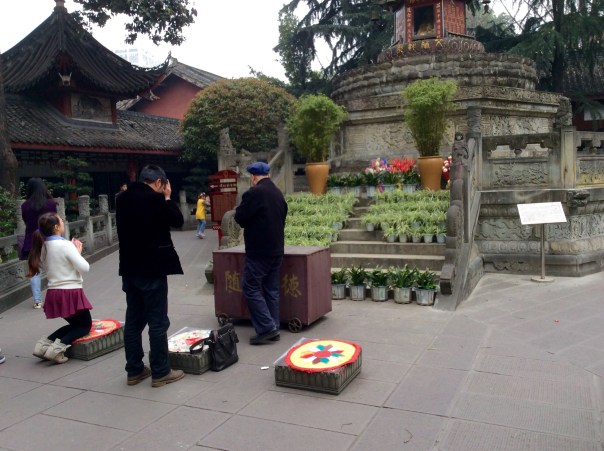
Today we took a taxi to the Wenshu Buddhist Monastery, a peaceful collection of temples and gardens. image

image
image

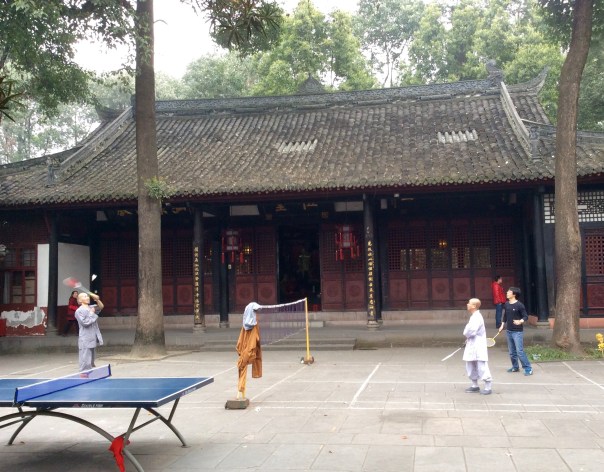
We watched monks playing badminton and observed more people praying than we had in Xi’an.

We met an American professor who lives in China, showing his niece and nephew the sights, and a family from Canada traveling with a private guide. Everyone we speak with shares the opinion that what we are doing – traveling solo – just can’t be done.

There are ponds of fish here, and big black frogs and hundreds of turtles.

The skull of a bodhisattva resides here, according to our resources, and Jim asked repeatedly, but the Chinese didn’t understand what he was asking. The Canadians’ guide understood, but told Jim the skull is not on display. Oh well!  A lovely visit.image

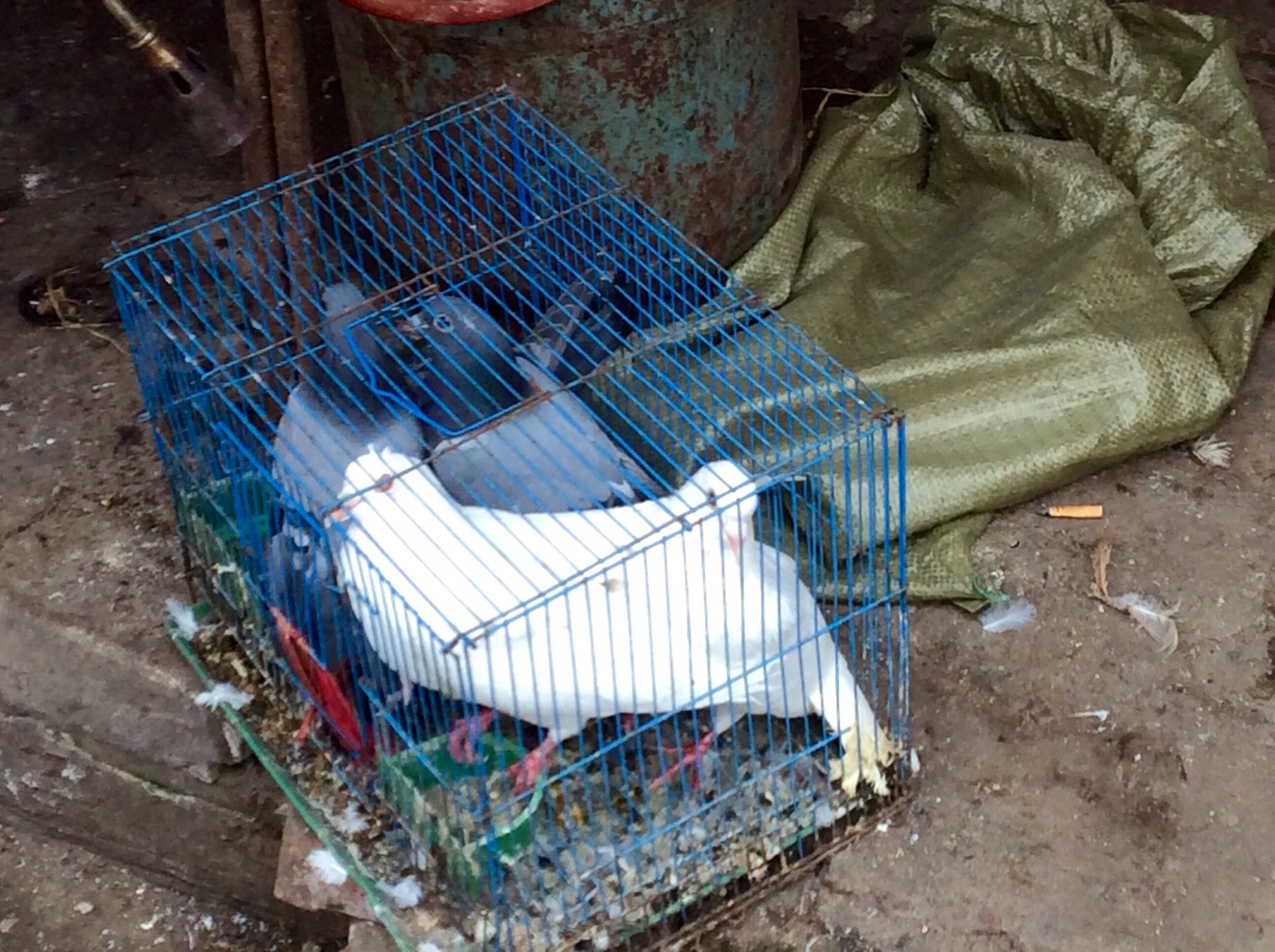
In the afternoon, we walked through a street market, selling everything from pig trotters to pigeons.image

image

Walking back from supper, there was lots of music in the streets, and we stopped to watch a group of middle-aged women doing a sort of line dance – Chinese Electric Slide!

Xi’an – the City Wall

3/14 – Another Xi’an morning – if only we could see the sun… Here’s the view out our hotel window. Xi’an is even more polluted than Beijing – yuck!

IMG_8076

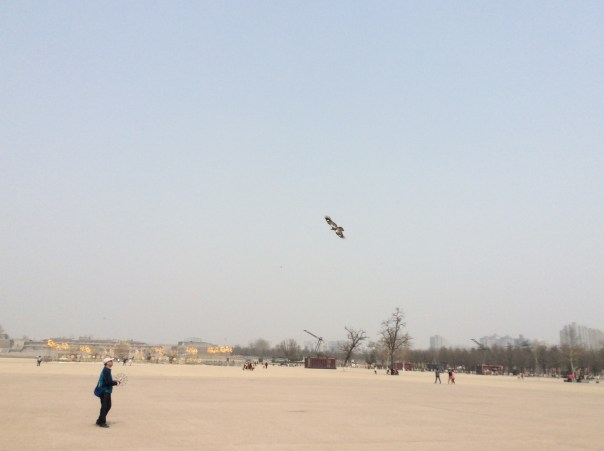
As we won’t be going north to Beijing to see the Great Wall, we decided to head south today to see the City Wall of Xi’an.  It’s a mild Saturday, and folks are out enjoying the spring weather.  We stopped at a concrete park to watch kids of all ages flying kites.IMG_8078

A taxi ride in bumper-to-bumper traffic got us to the southern entrance, where we paid 60 yuan ($10) apiece to climb to the top of the wall.  Jim remembered his trip here 30 years ago, and the plaques that described how the wall acted as the primary defense for the city. Soldiers rained fire and arrows on any would-be intruders.

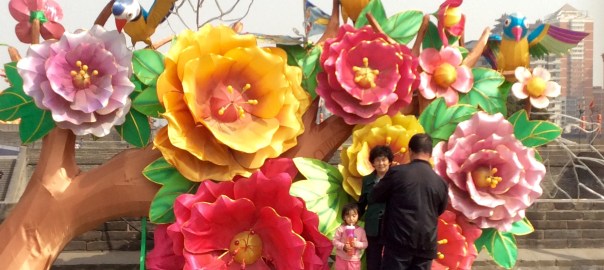
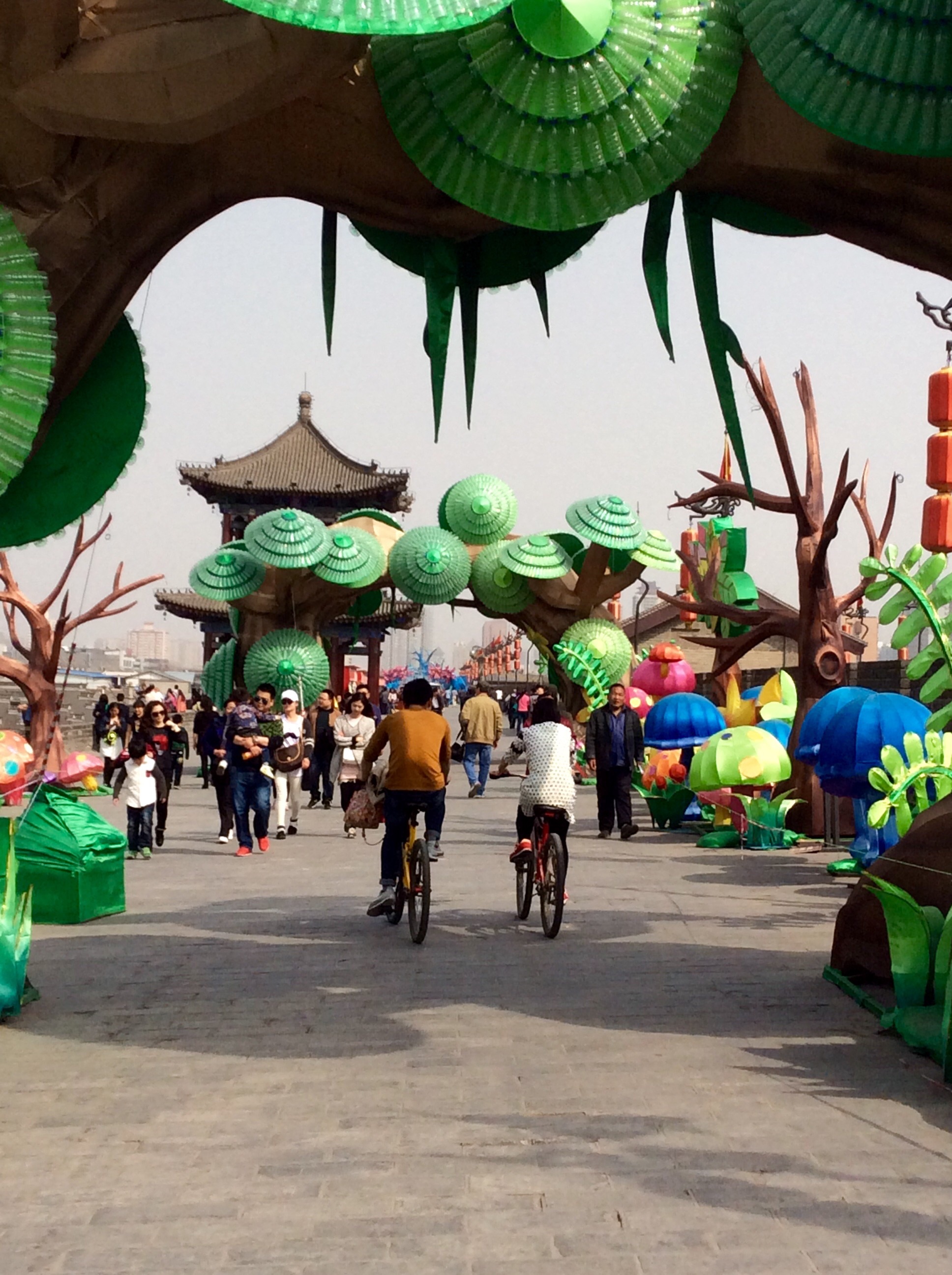
When we got to the top, we found a wonderland of giant flowers, animals and cartoon characters.  The figures are lit up in the evenings.  
image
image

Children were blowing bubbles and having their pictures taken.

Folks rented bicycles or strolled down the length of the wall.  At the end were food stalls, where everything from ice cream to fried squid could be purchased.
image 

We noticed that attire with (almost) English words emblazoned on them are very popular among the young and stylish.  We saw shirts paying homage to San Rancisco and Flawrida, and one elderly gentleman proudly sporting a ball cap emblazoned DOPE.  I recalled that a few years back it was stylish for young Americans to get Chinese symbols tattooed on their skin.  I always wondered what the tattoos actually said…

 We walked until we were tired, then turned around for the journey home. A nice excursion for our last day in Xi’an.

Xi’an acupuncture

Eliese suggested that I seek out some traditional Chinese medicine to help speed the healing of my fractured humerus. Here is Jim’s account of our morning at the Hospital of Traditional Chinese Medicine. Happy to serve as blog fodder for a good cause! KF

beinghere2014's avatarBeinghere

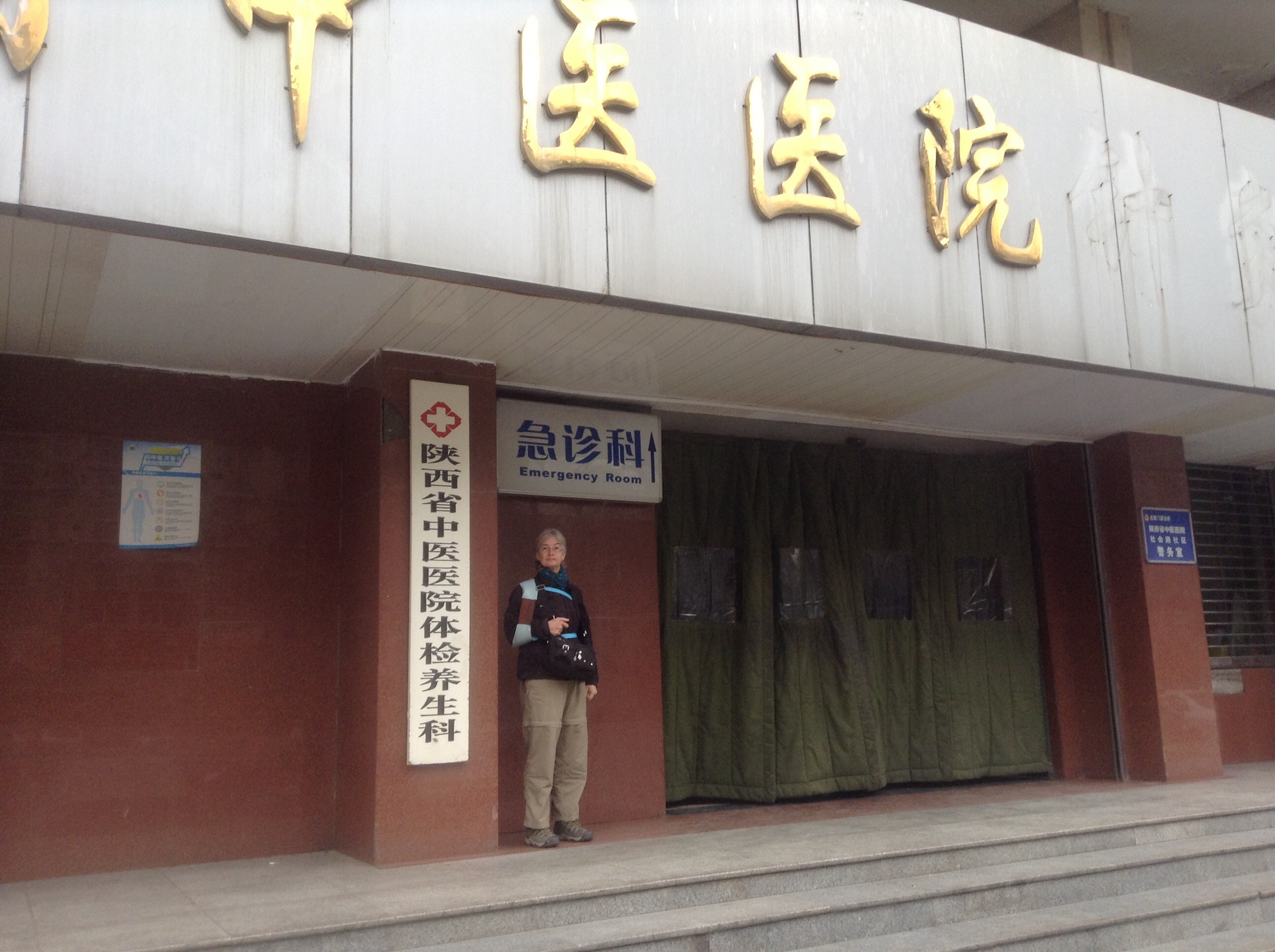
We are going to a Traditional Chinese Medicine (TCM) hospital to seek acupuncture treatment for Karen’s broken shoulder bone. We look online and get the name of a nearby traditional medicine hospital. We go to an expensive international hotel, where a reception desk lady speaks English. She says the traditional hospital has moved and she gives us the name of another hospital, writing it out in Chinese. Another lady, a guest at the hotel, says that going there is a good idea.

image

We take a taxi to the Shaanxi Province Hospital of Traditional Chinese Medicine (Emergency Room entrance).

image

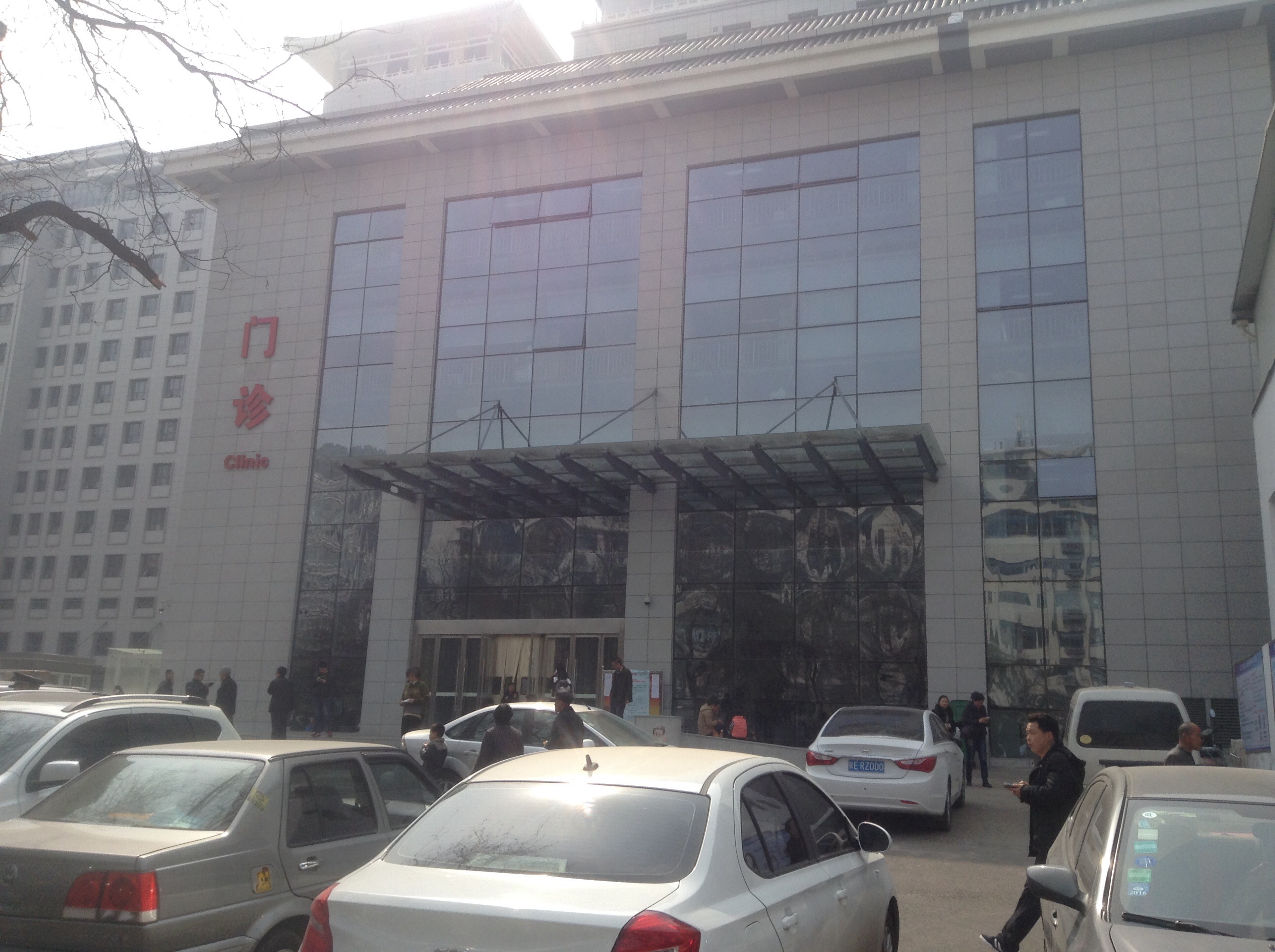
They send us next door to the out-patient clinic.

image

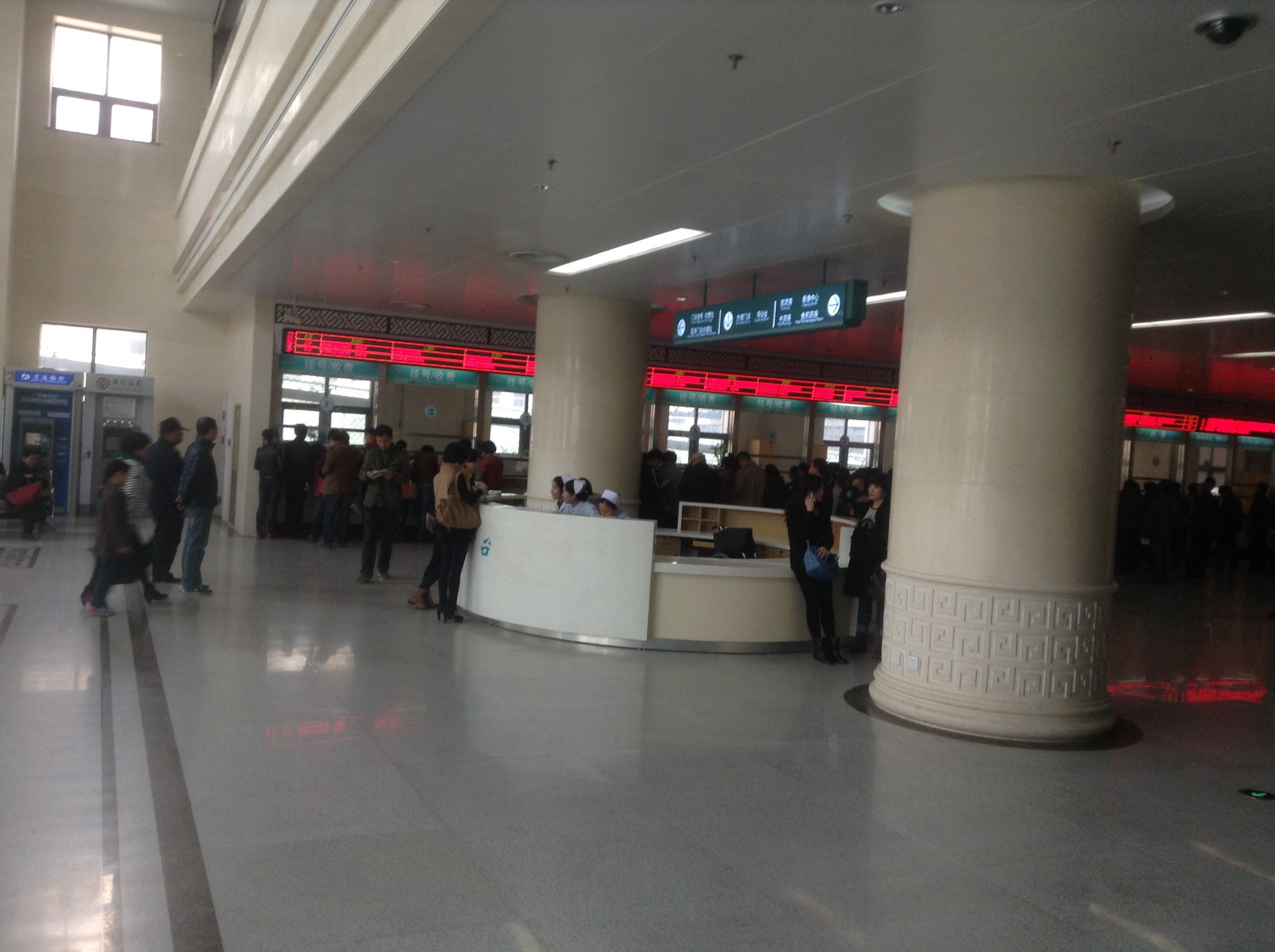
The nurse directs us to “orthopedics” — we have not registered or “checked in” in any way — but this may be because of our poor Chinese language skills.
Instead of waiting outside, we stand in the office with two doctors while they…

View original post 732 more words

Xi’an – the Terracotta Warriors and Horses

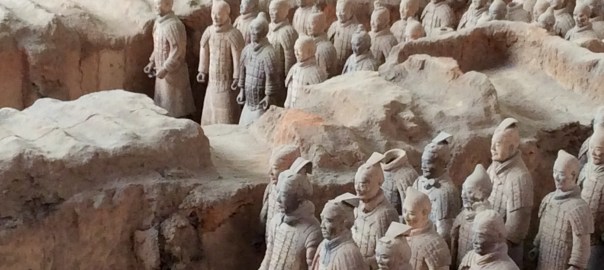
3/12 – In the 3rd century BCE, Emperor Qin Shi Huang decided he needed a vast army to protect him in the afterlife. He enlisted thousands of slaves to create over 8000 thousand terracotta warriors, armed with bronze weapons, and over 500 horses and wagons, to surround his tomb. Word has it that he then killed all the slaves, so no one would reveal the location of the army or the tomb.

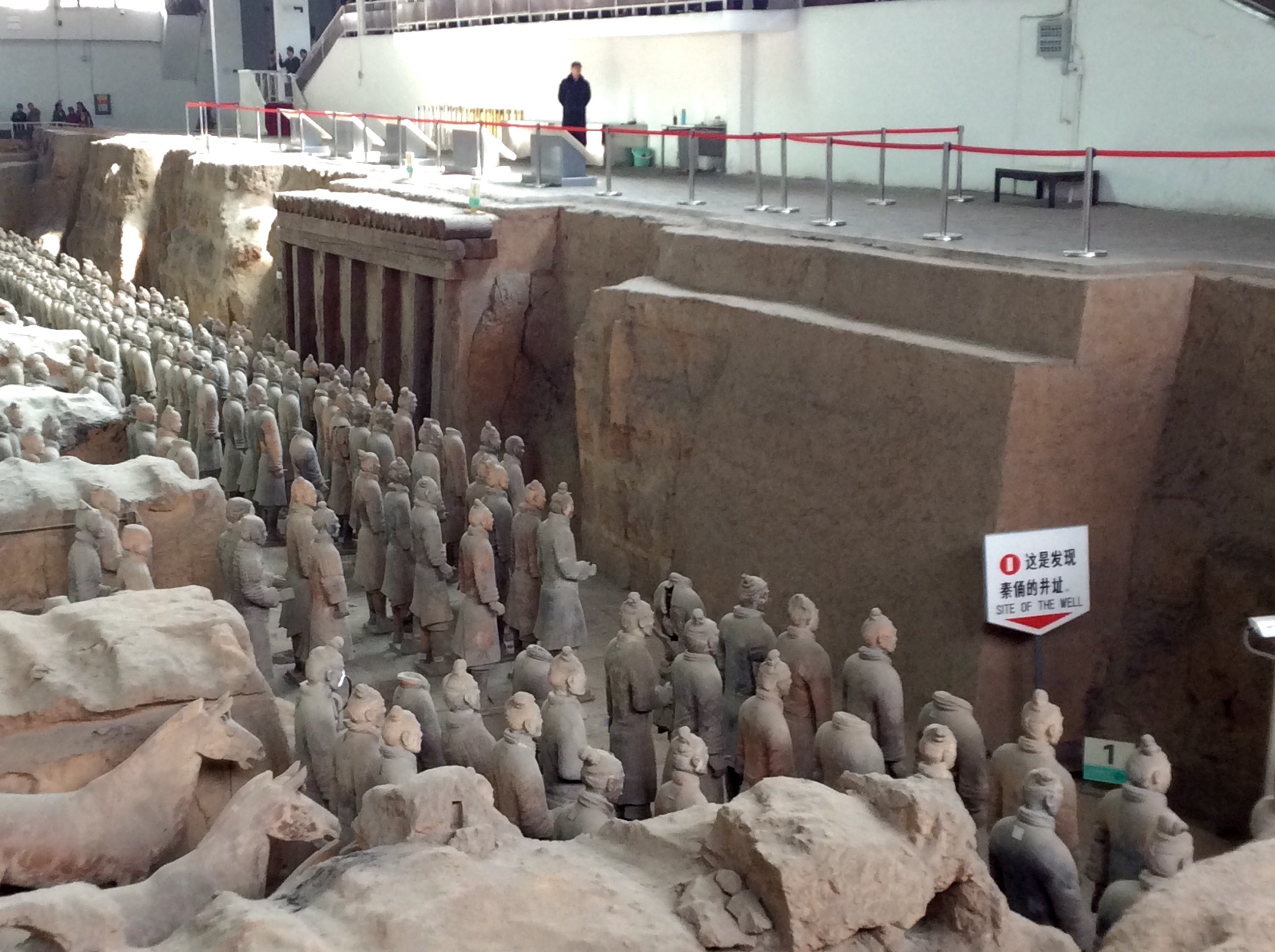
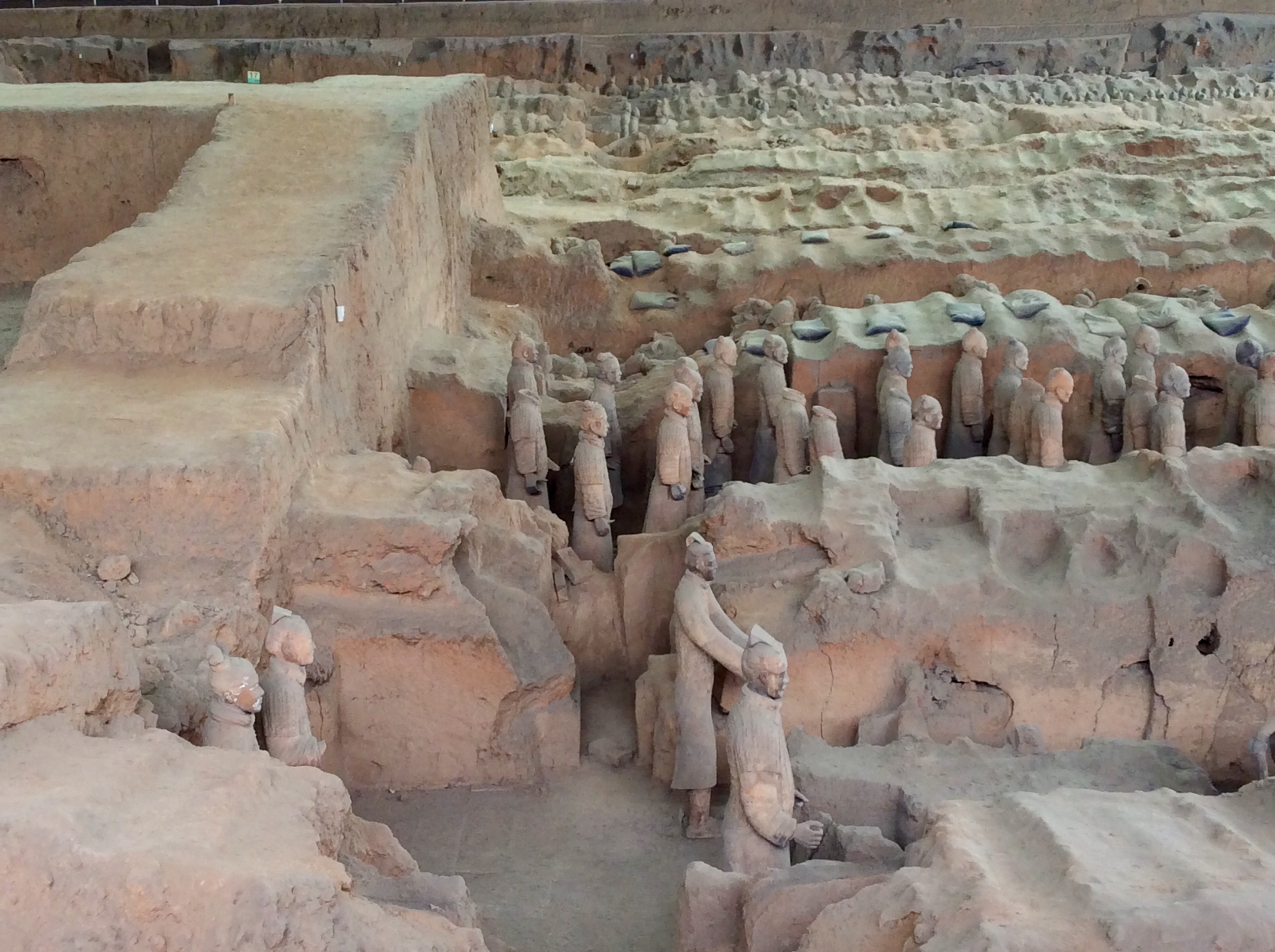
In 1974, a farmer, digging a well outside Xi’an, started to bring up bits of clay. He had inadvertently tapped into Pit number 1 of the collection of life-size terracotta figures, buried for 2400 years. Archeologists have been piecing them together ever since. See the location of the farmer’s well in lower right.image

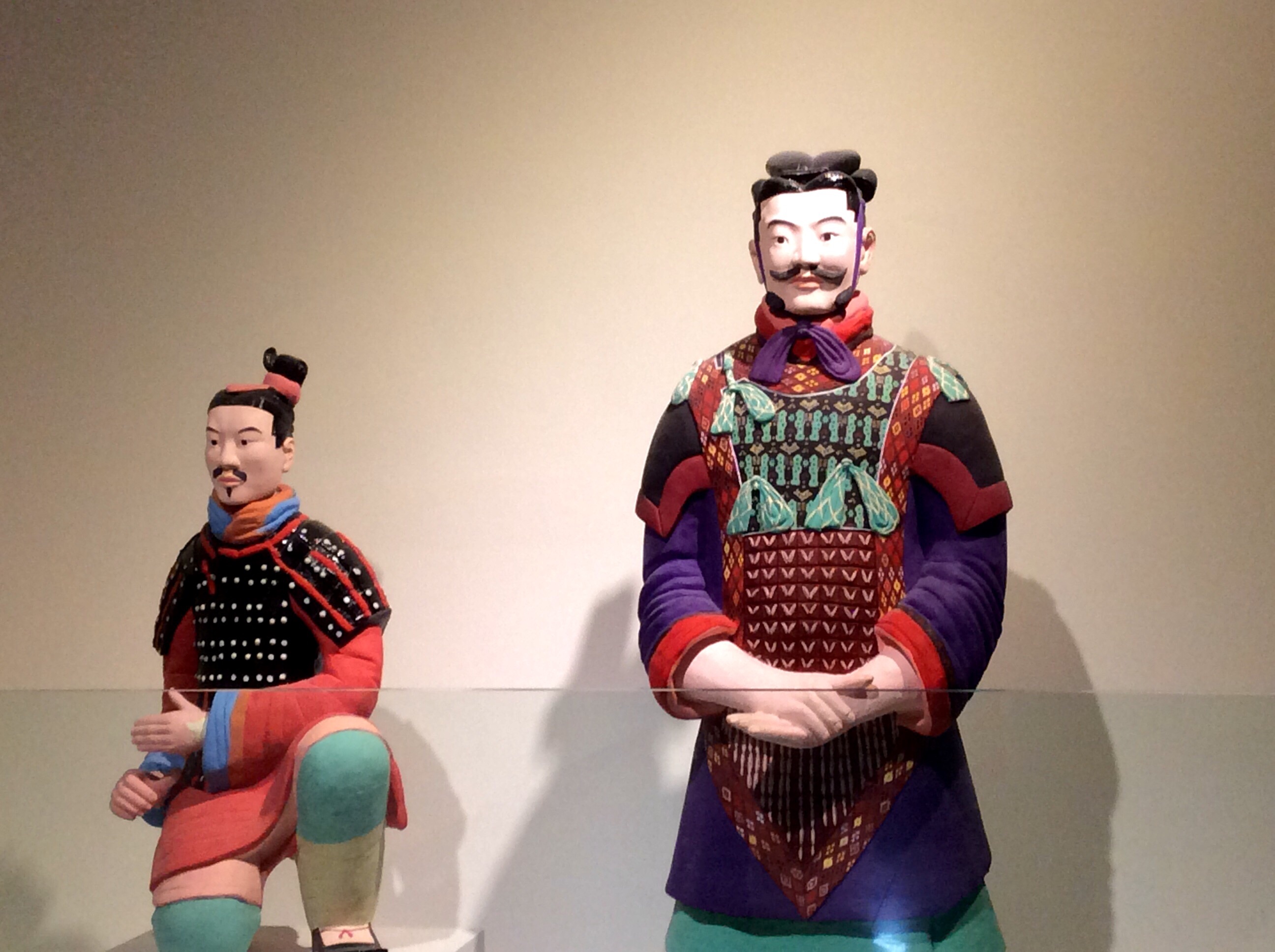
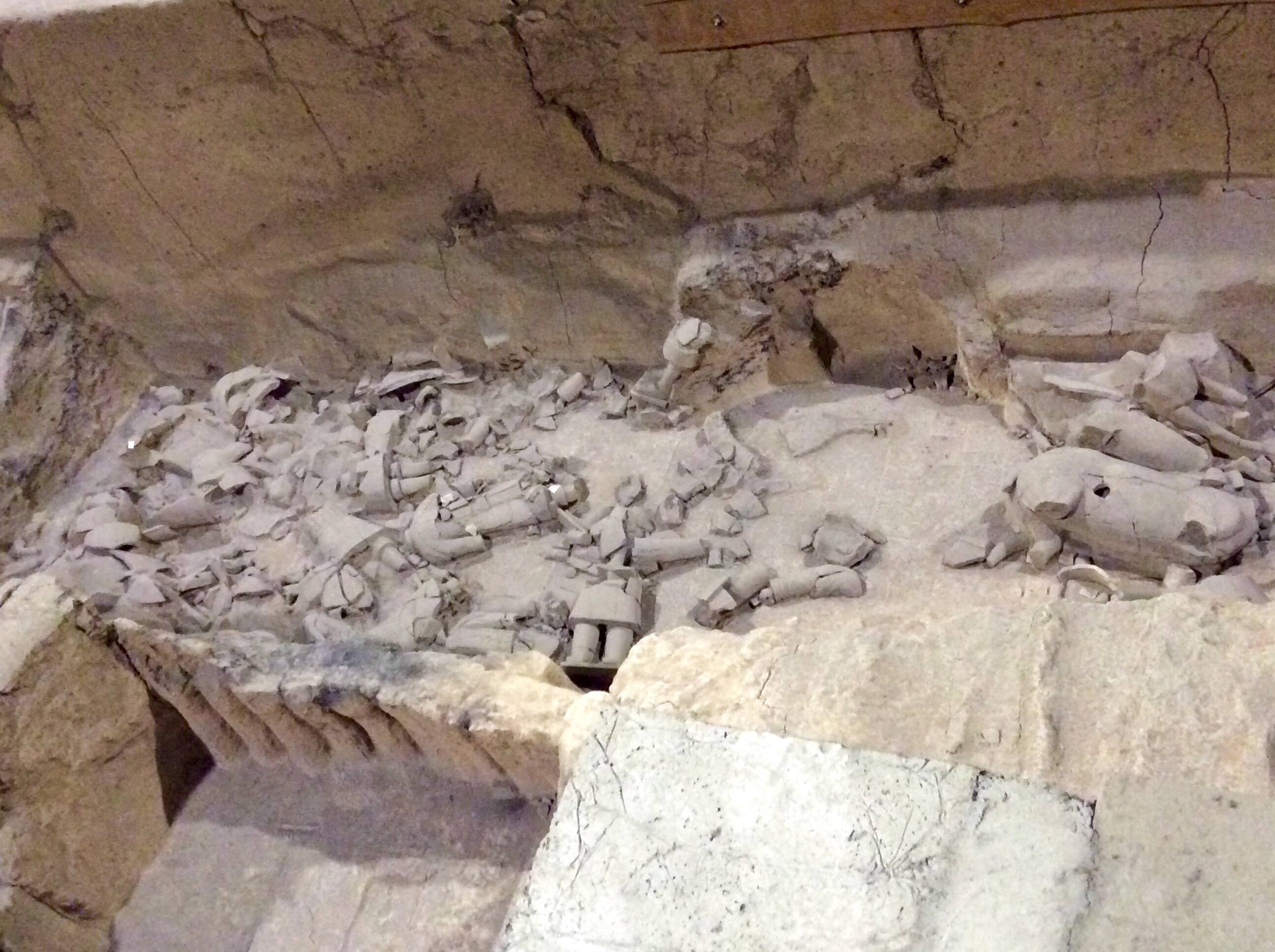
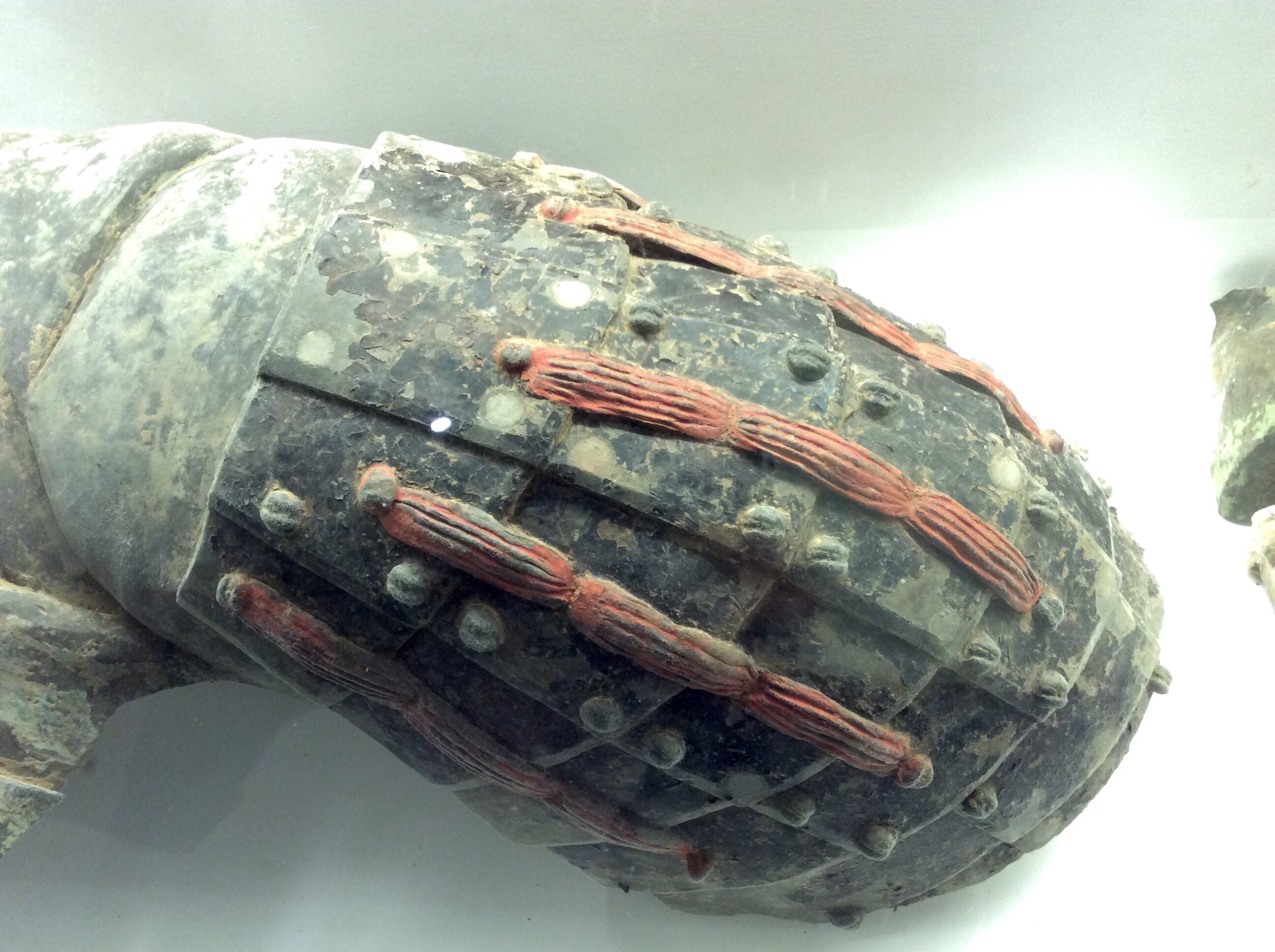
We took an hour’s bus ride from the train station (take bus 603 or green bus 915, they leave every 15 minutes for 8 yuan – you do NOT need a private tour or a guide) to the site, where three huge pits are being excavated. As soon as the once brightly painted figures were subjected to the dry, polluted air, the paint curled and fell off within seconds. This is how the figures once looked.image

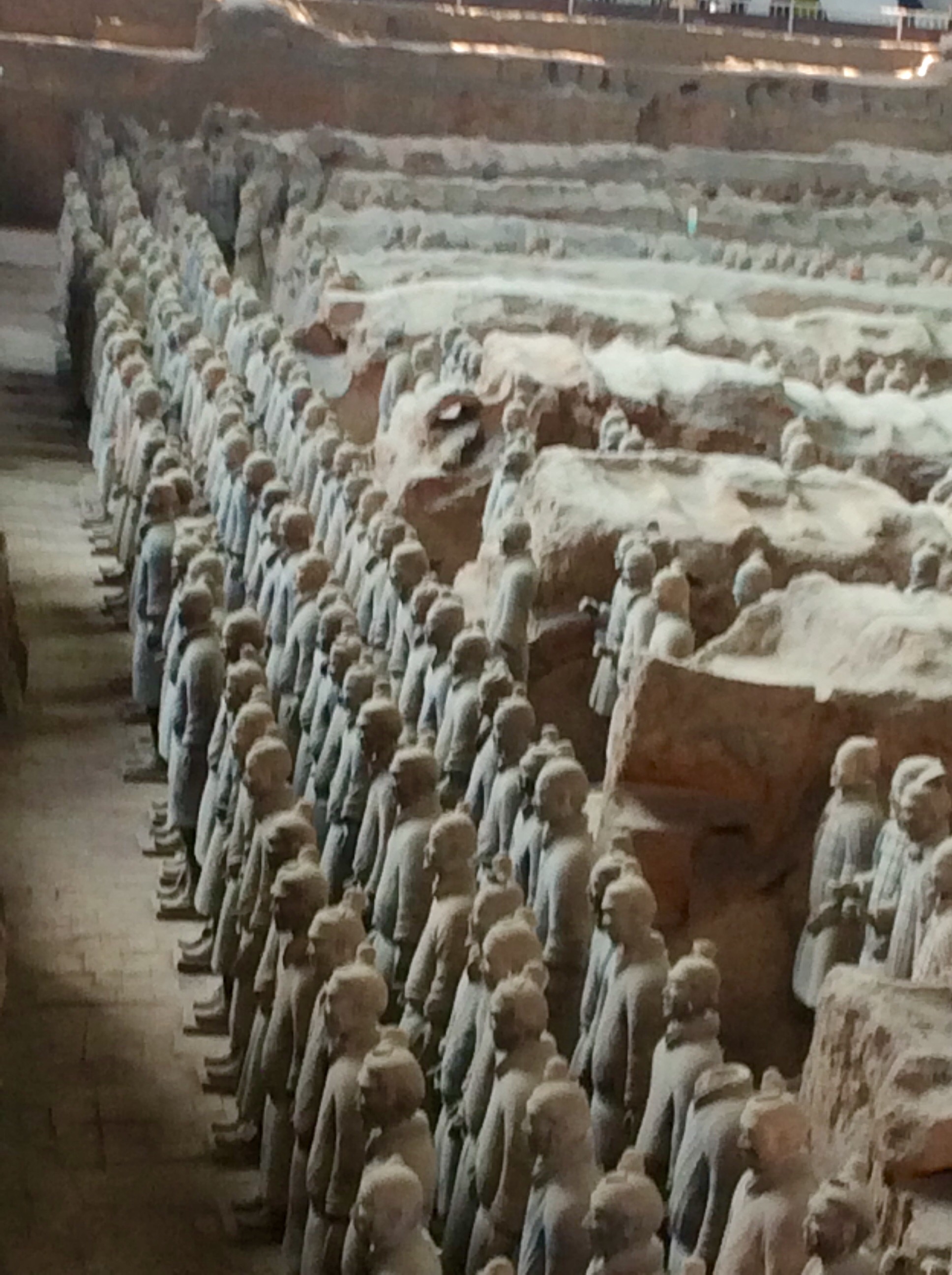
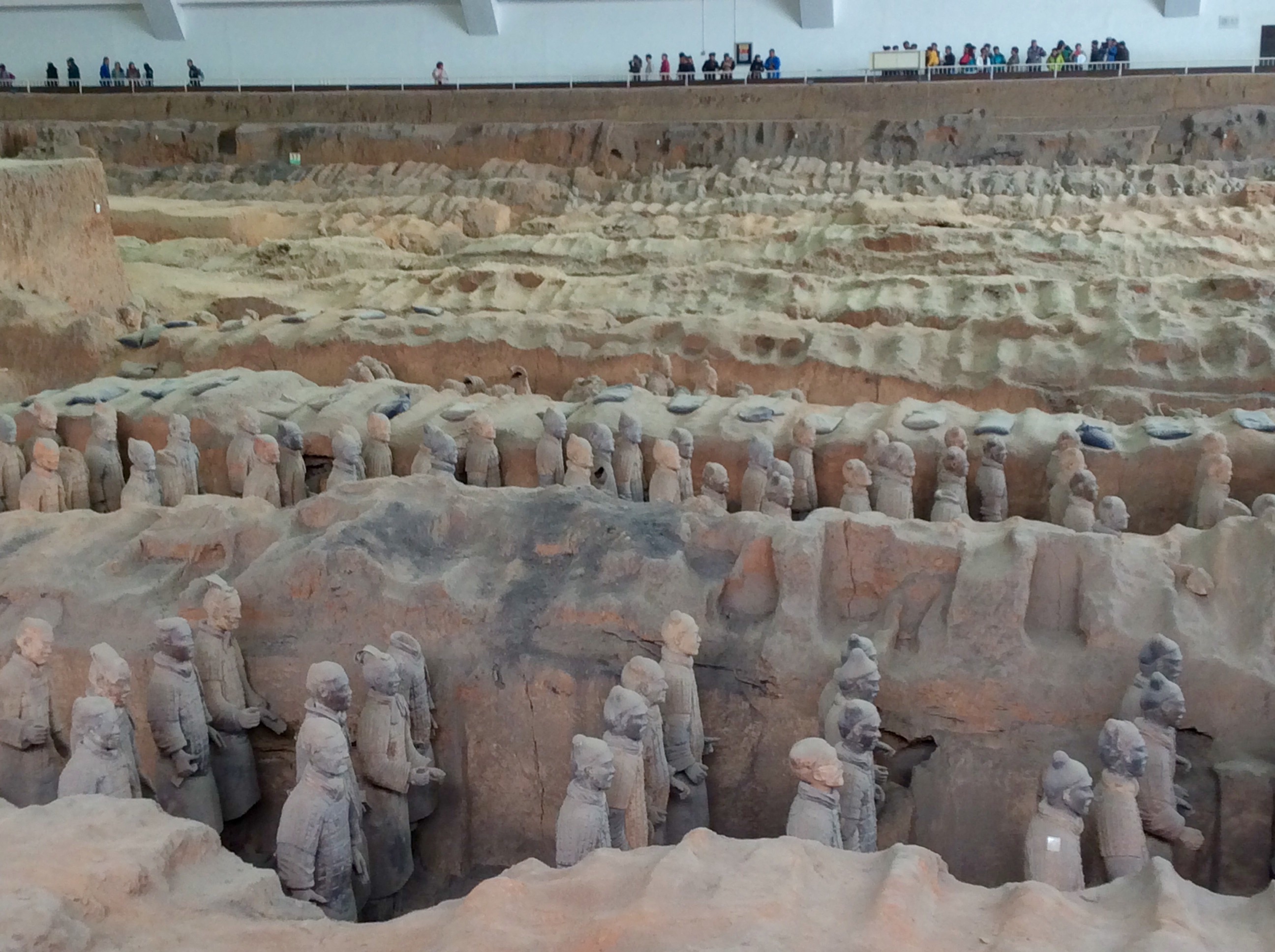
After exposing over 2000 figures in the first pit, and having them turn mud-brown, archeologists are now taking their time exposing more, to enable scientists to develop better methods to preserve them.image

The first pit was pretty impressive. image

image
imageimage

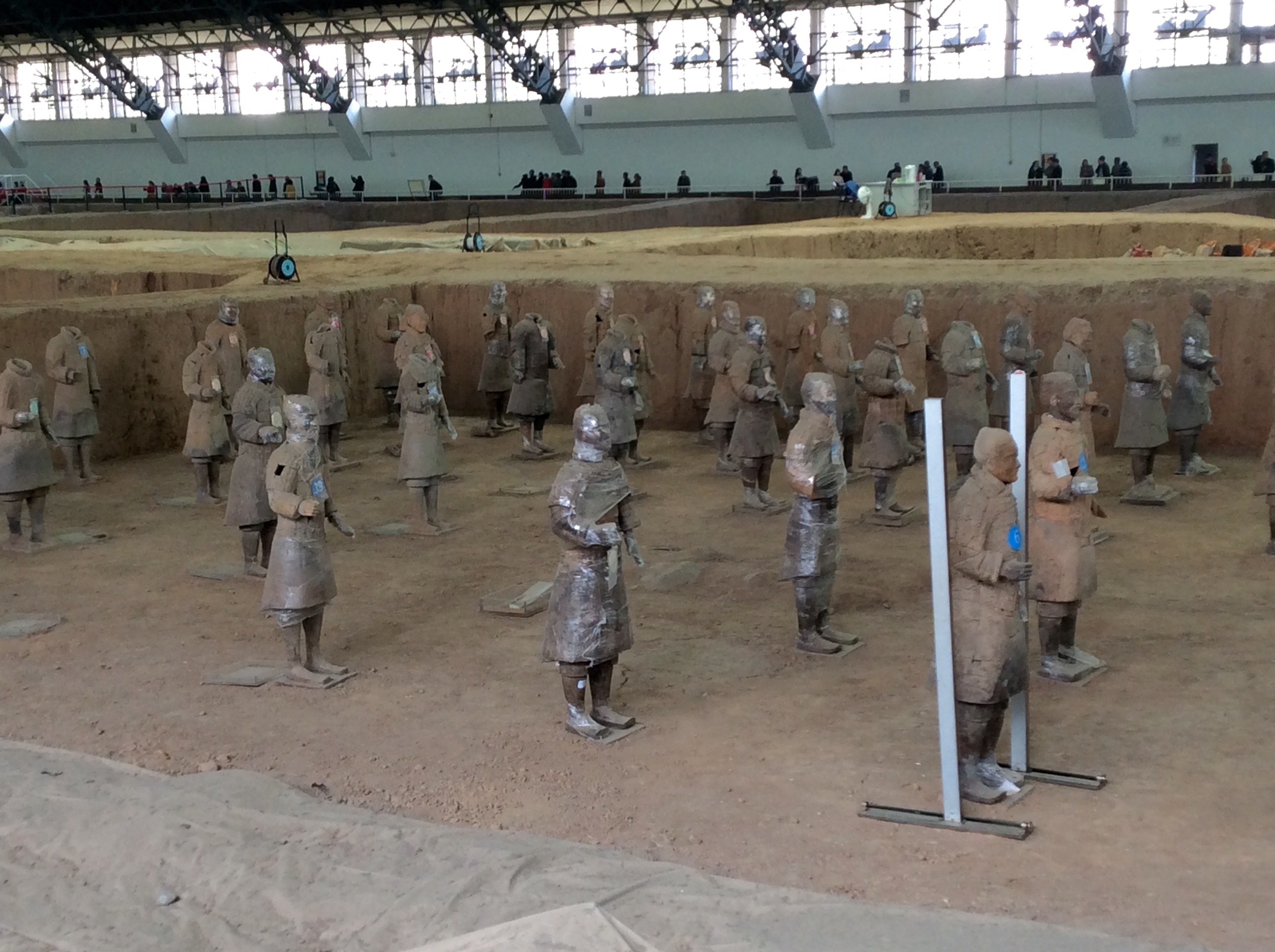
Here are some soldiers being reassembled.image

image

image

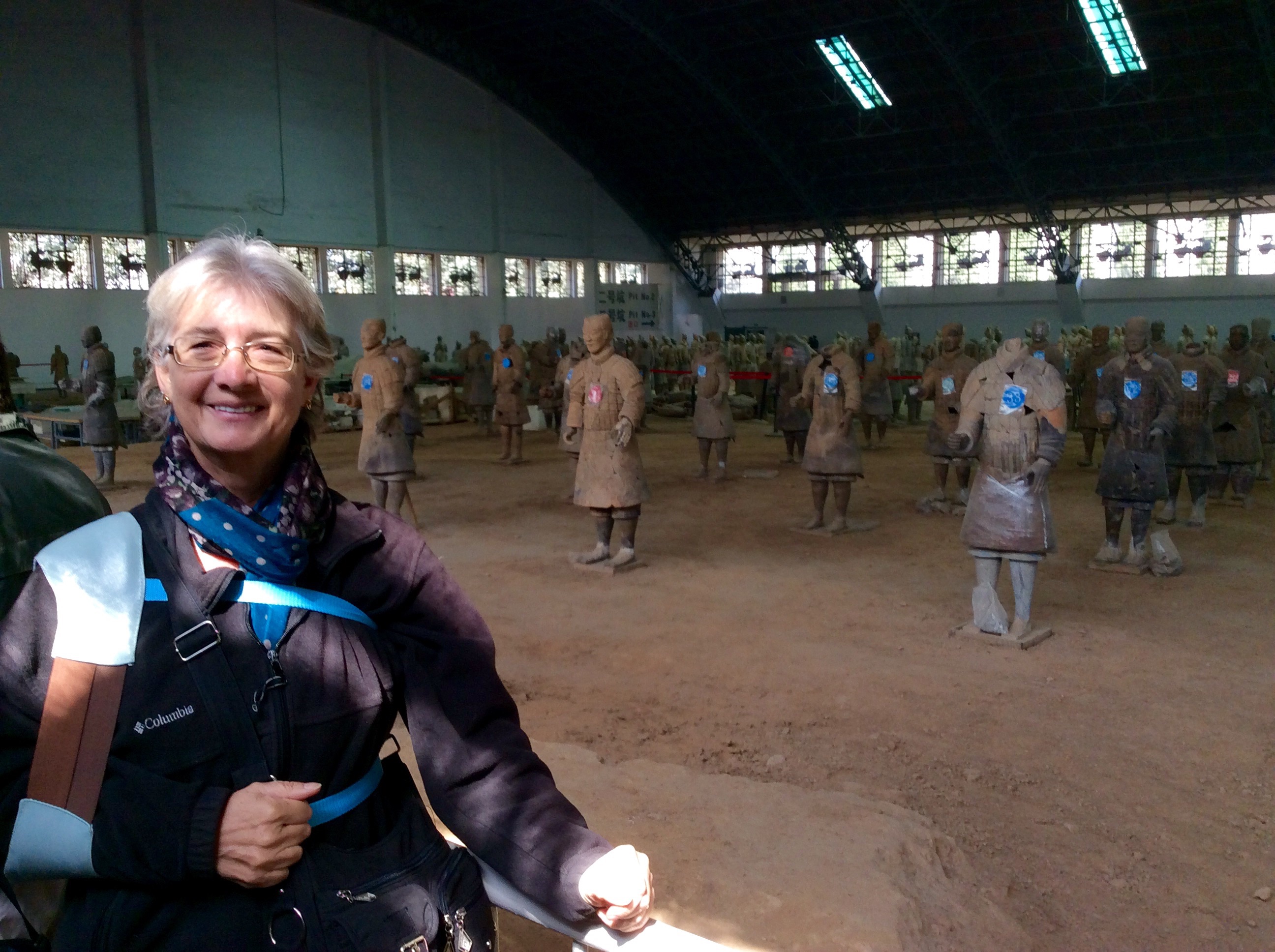
The second and third pits show more recent excavation, with many warrior and horse figures still buried.imageimage

Some pieces retained a bit of color, and are preserved under glass. image

Although molds were used to cast each piece of the figures so they could be fired and put together in an assembly-line fashion, each face was formed individually with clay to make it unique. image

image

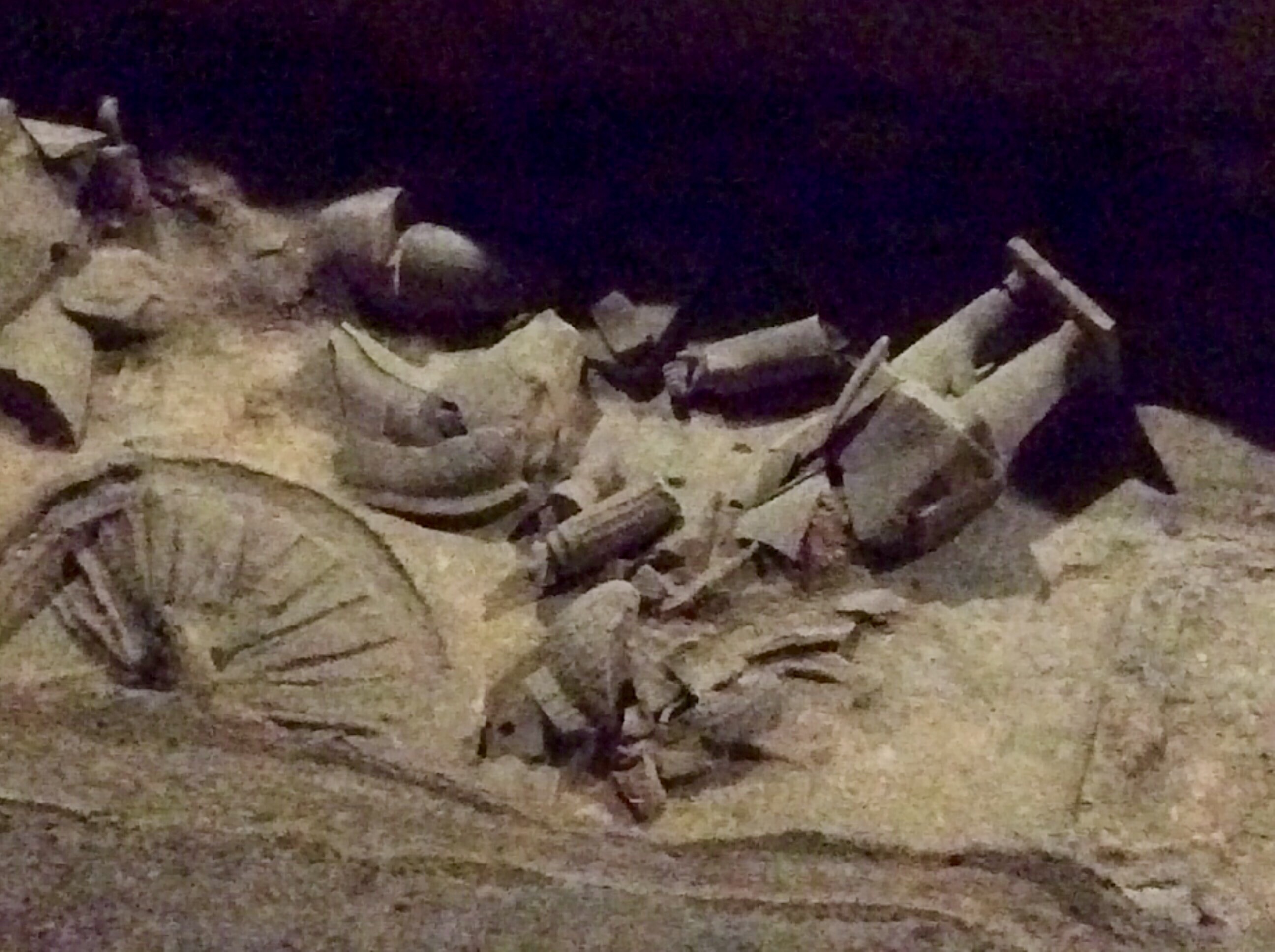
The horses once pulled wooden carts, but the wood has all decayed away. This is the impression of a wagon wheel from Pit 2.image

There are archers, swordsman, charioteers, musicians, officers and infantry, as well as horses. It is believed that Pit 3 houses a command post for officers.

Like other wonders of the world, you have to give credit to those who thought so extravagantly, while simultaneously wondering what this emperor accomplished in his lifetime to justify his glorious death. His tomb remains intact.

Outside, it was 70 degrees, and the cherry blossoms are starting to bloom!image

Xi’an – the Great Wild Goose Pagoda

3/11 – Today we ventured south to visit the Great Wild Goose Pagoda. Jim taught here in Xi’an, and visited the pagoda 30 years ago – I wonder if it’s changed?

For some reason, we had a hard time convincing a taxi to take us there, so we ended up in a three-wheeled tuk-tuk like the ones in India – two stroke engine, soft sides, hard bench, no shock absorbers.  Talk about your wild rides – we went the wrong way down one way streets, flew over speed bumps, and passed buses on the right. My teeth rattled in my head, and I held onto Jim for dear life!

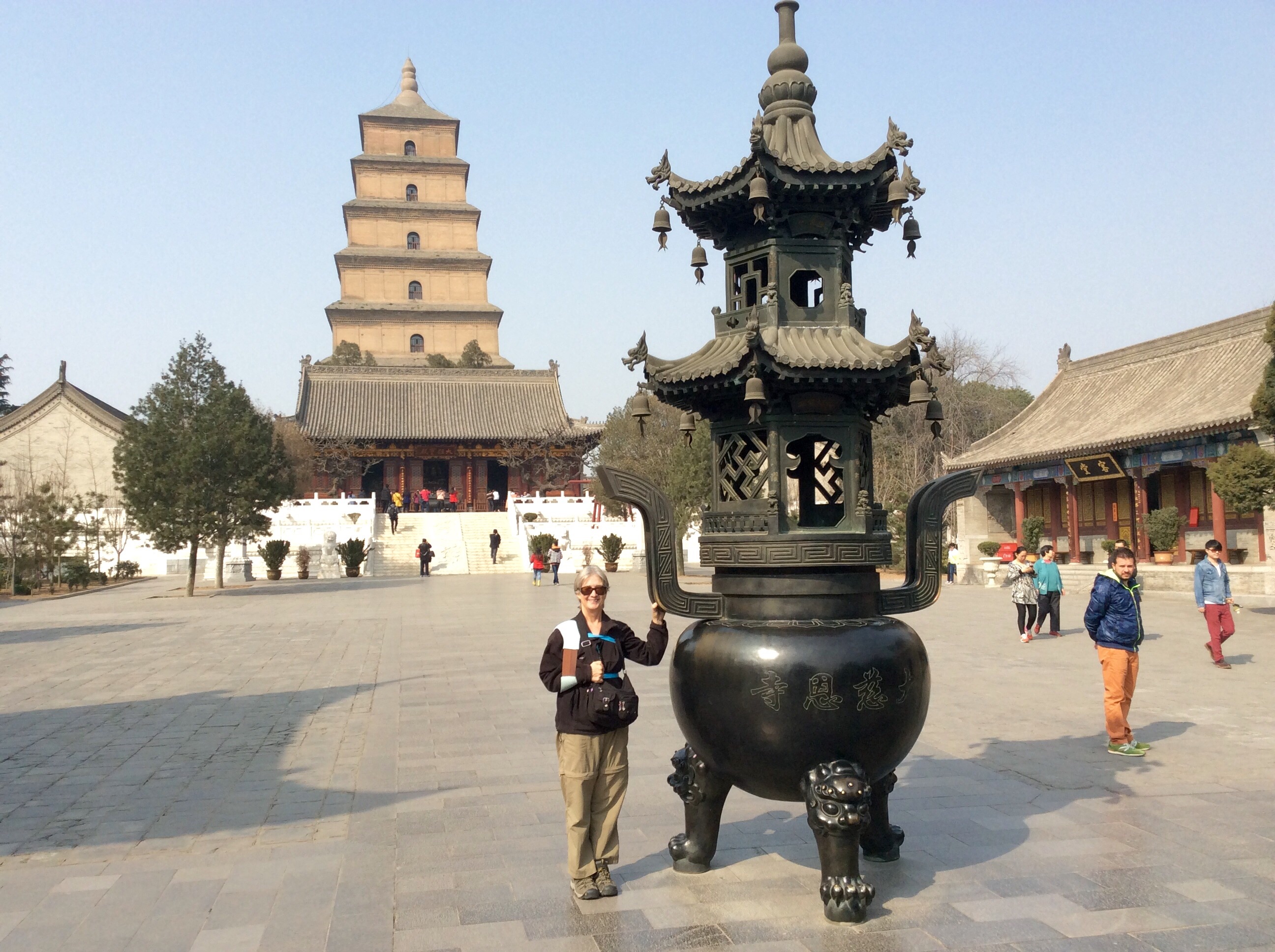
Four miles later, the pagoda came into view.  image

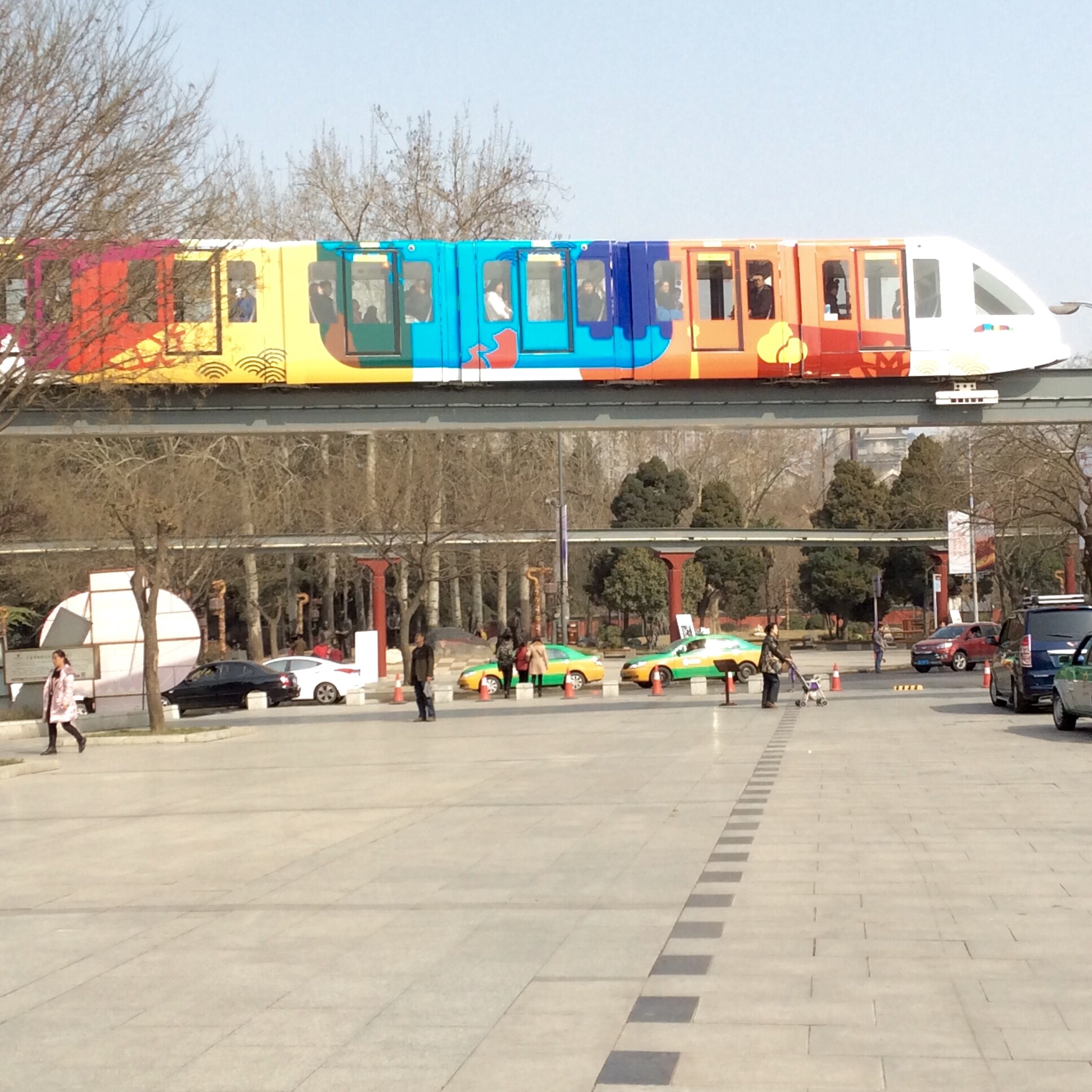
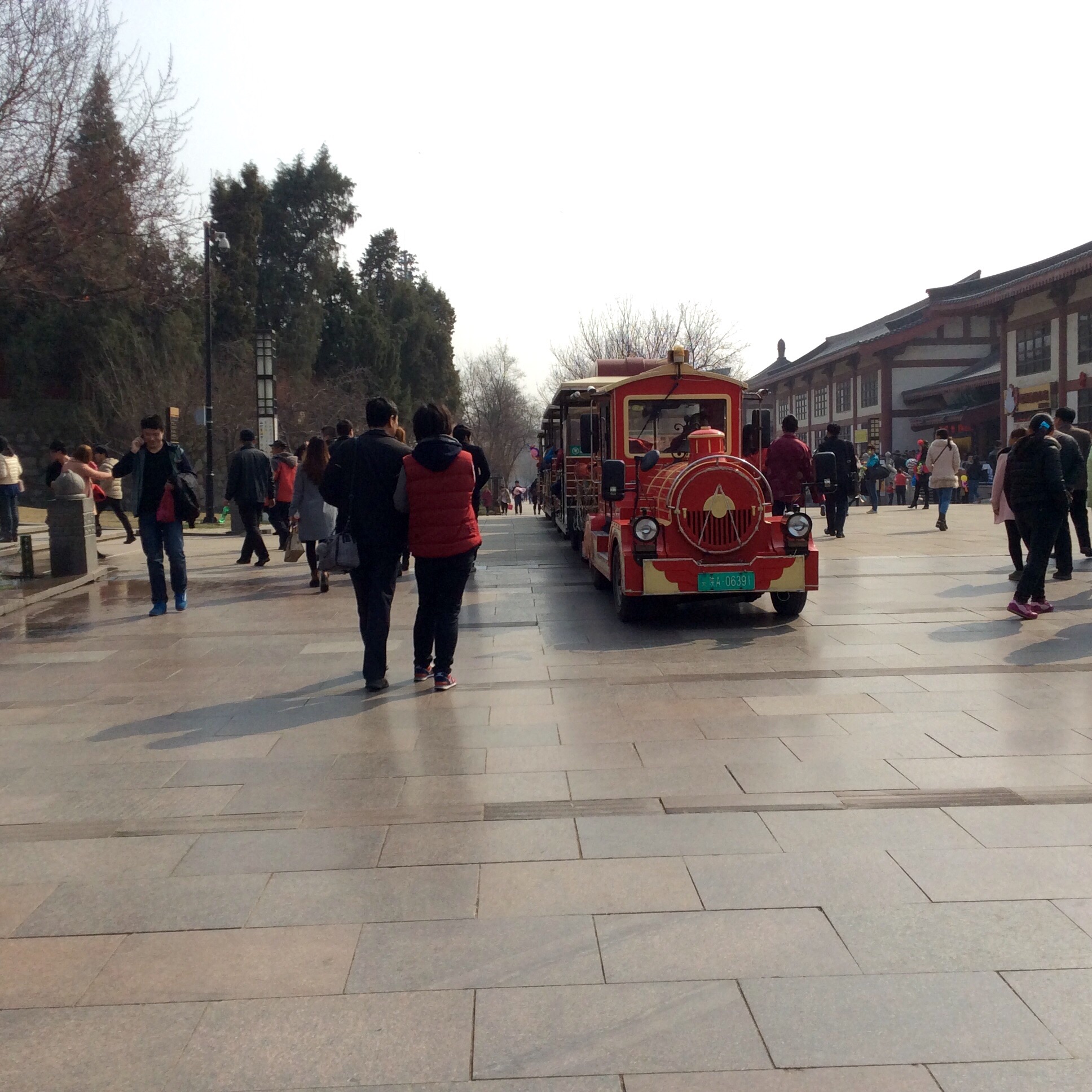
Since Jim had been here, a huge park was built around the pagoda, and it can be accessed by an overhead tram or a little trolley.imageimage

The day was warm and sunny (although gray with smog), and there were plenty of people out.  They sure love to mug it up for the camera – a series of sidewalk statues had folks lined up to take each other’s pictures.

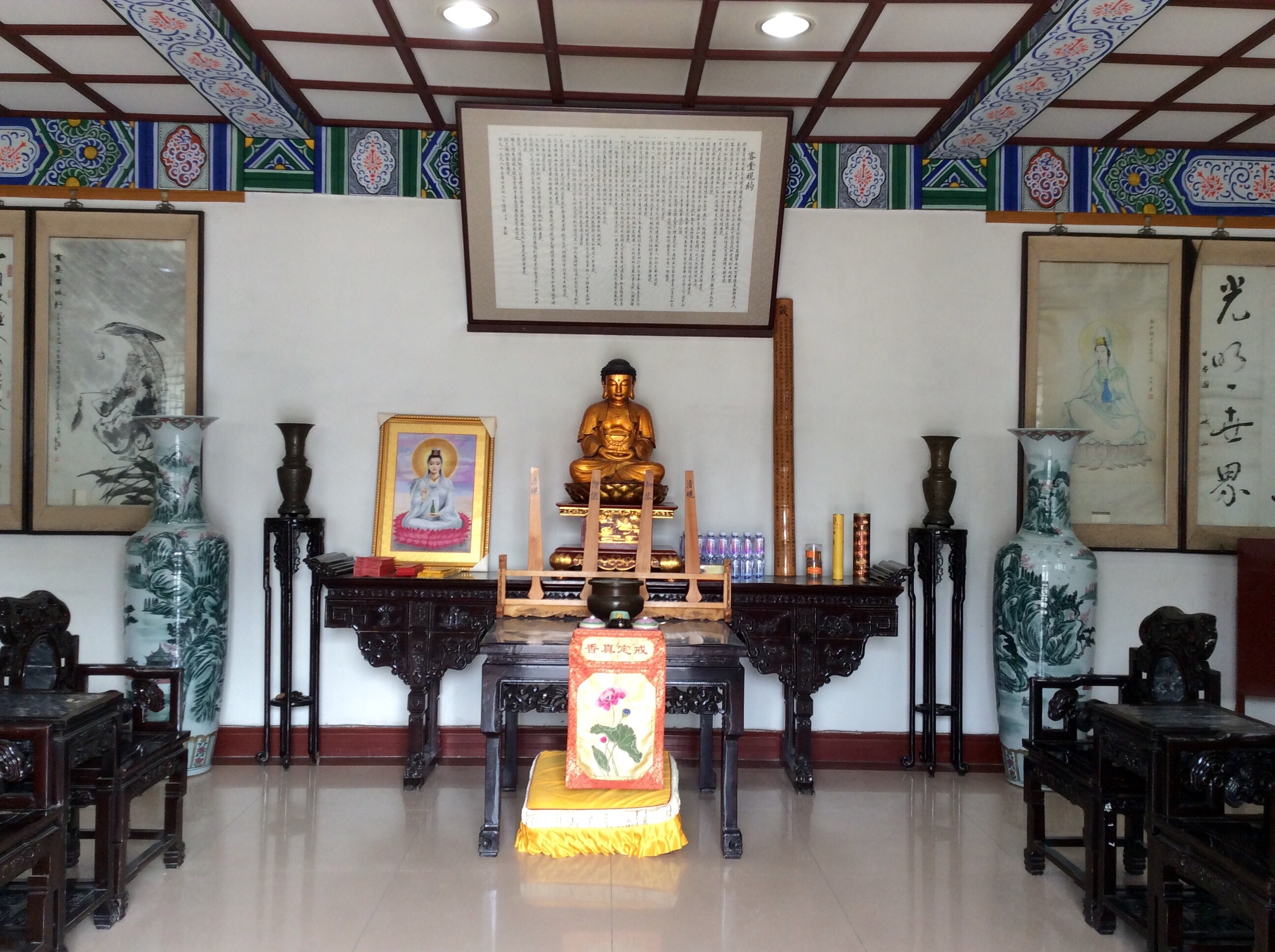
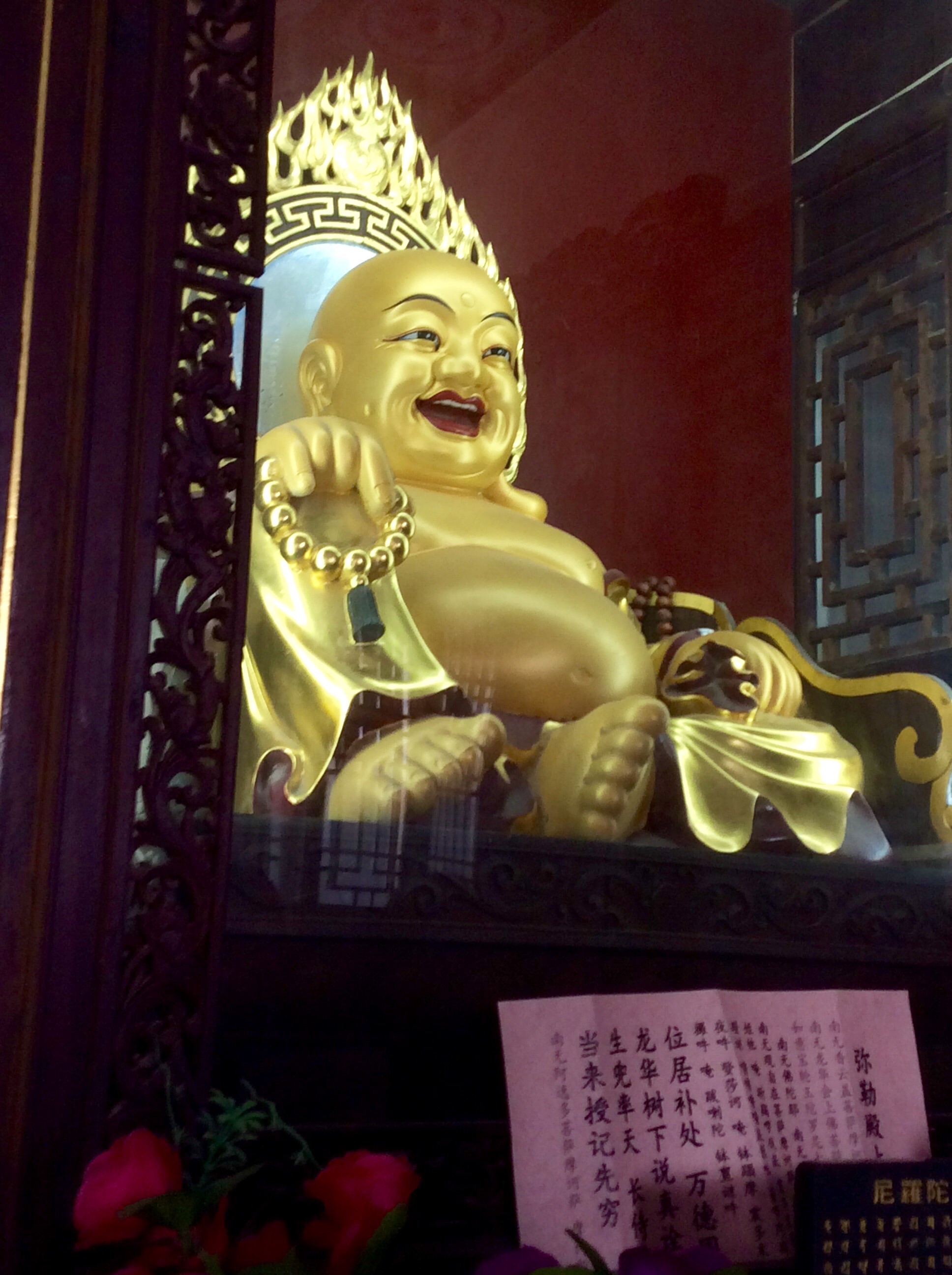
There were several displays surrounding the pagoda, with a variety of Buddhas.image

image

image

image

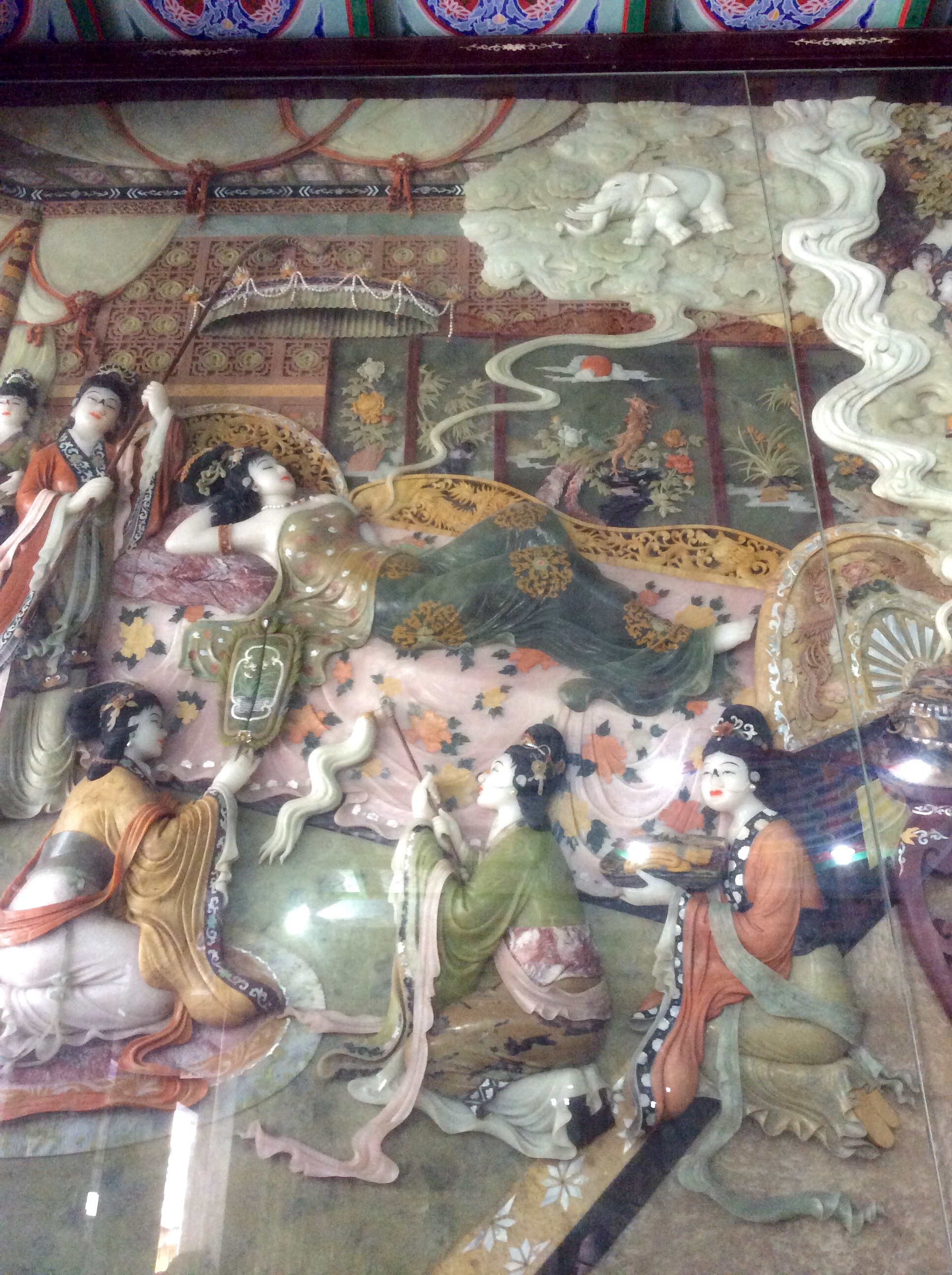
Buddha’s mother dreamed of a white elephant, signifying that she would give birth to an enlightened one.image

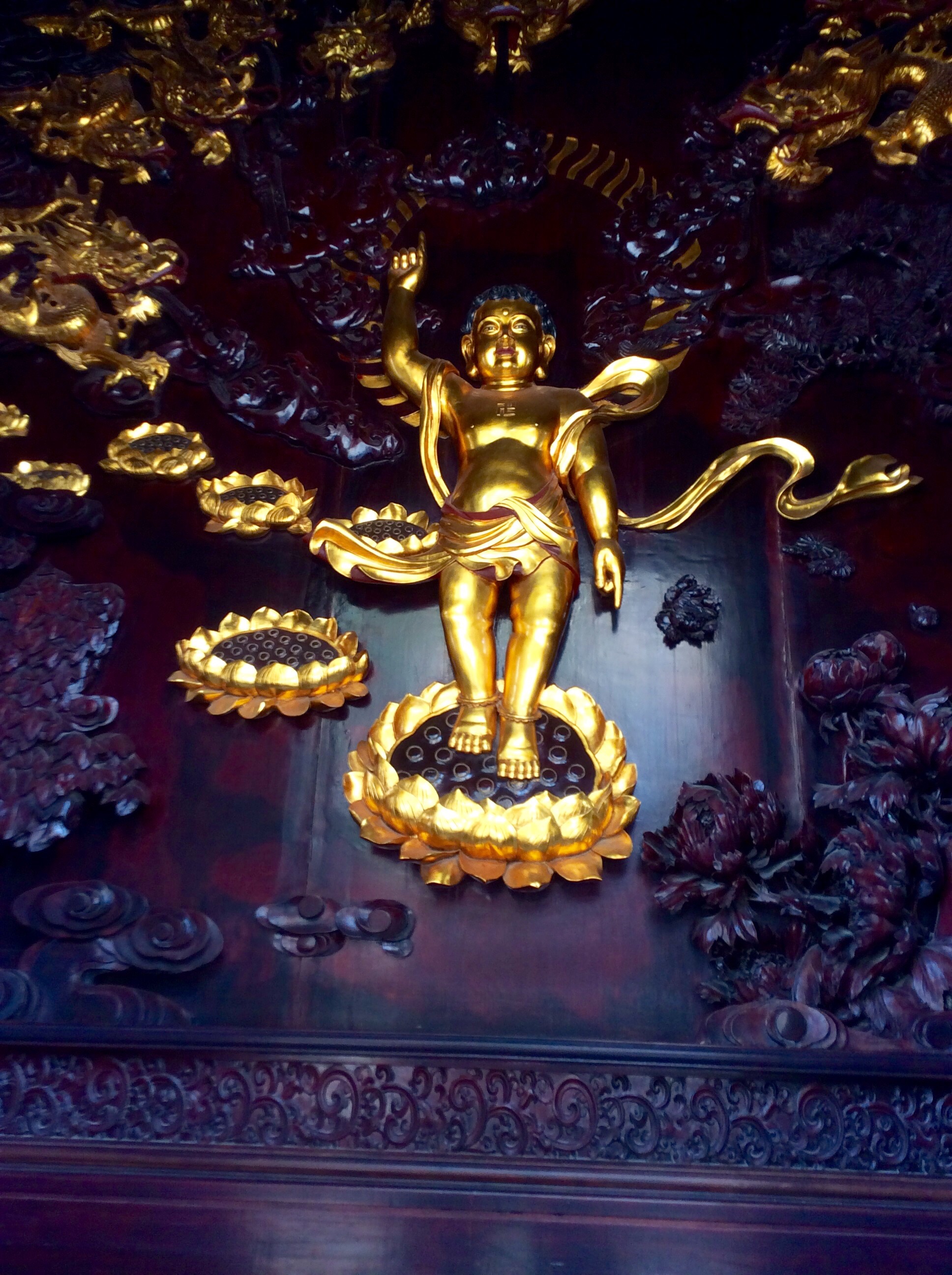
The birth of the Buddha.image

We only saw a few people praying – most were tourists.image

image

The seven story stone pagoda was built to protect the three baskets of sacred scrolls that the monk Xuanzang brought back from India in 628 CE. image

The views from the top – very smoggy.image

image

image

image

More images:

This is a nice city, very modern, and would be a fine place to live if not for the smog. I hope we get to see the sun someday soon!