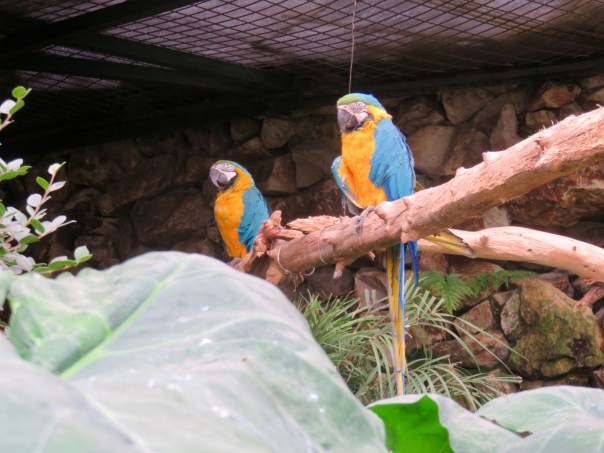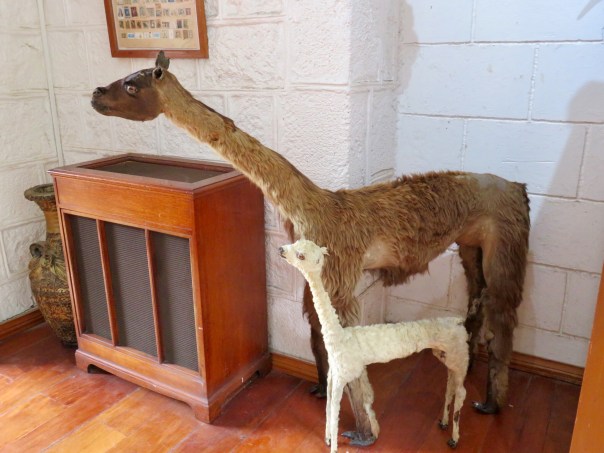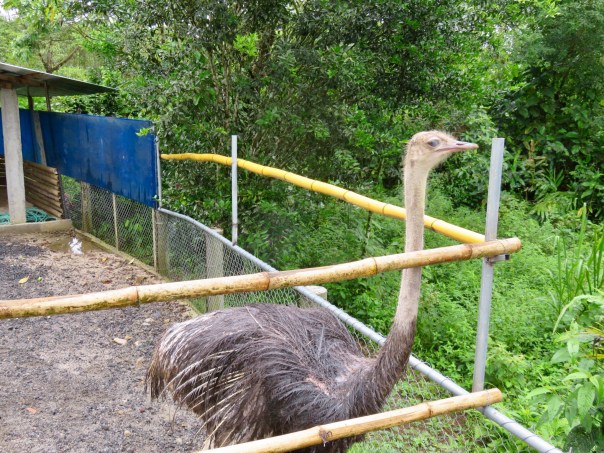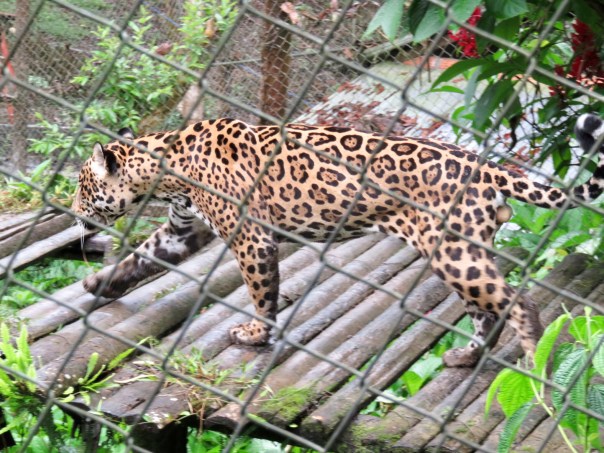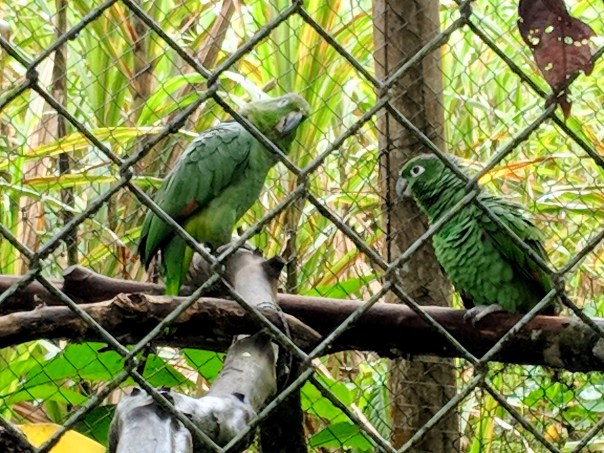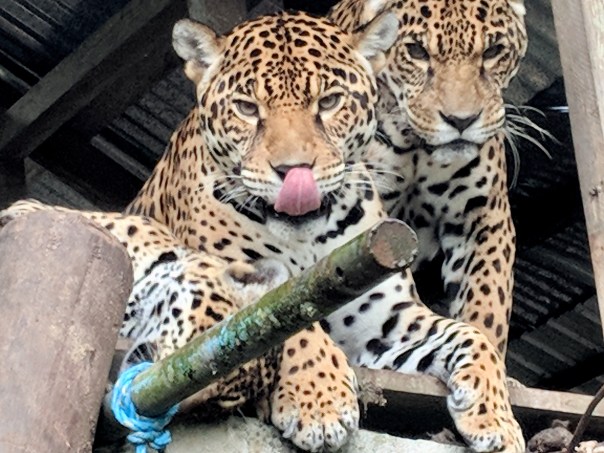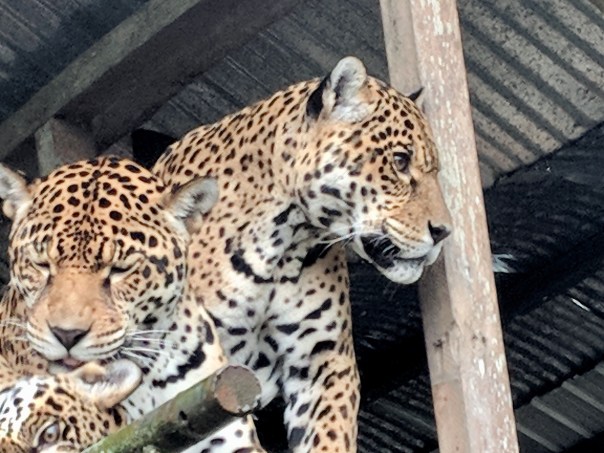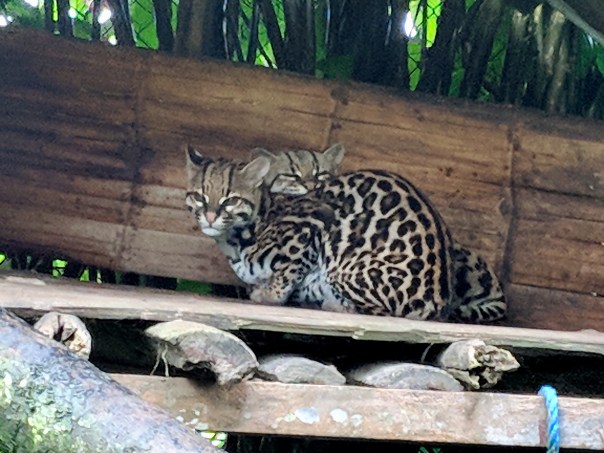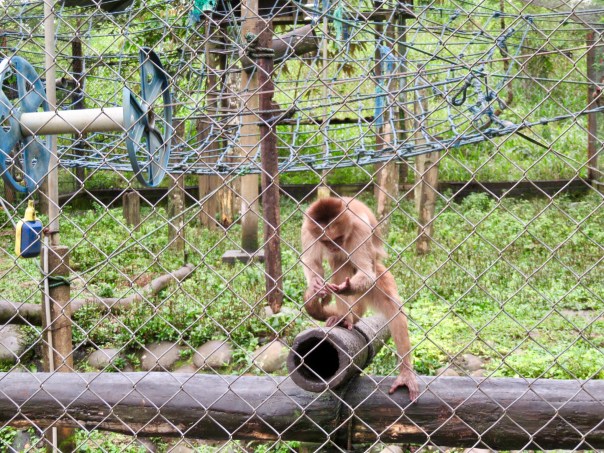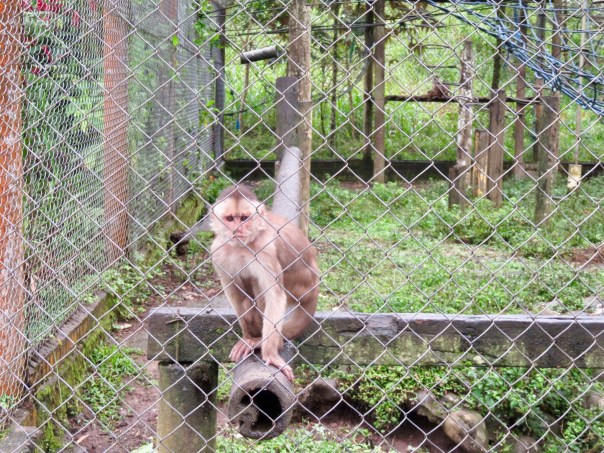
Jun 29 – Today was our day to visit Tarqui, and see the animals that have been rescued from being illegally trafficked. Tarqui is not a zoo per se, but a refuge for animals that cannot be returned to their native habitats. As many of the animals are African in origin, I’m not sure how they got to Ecuador in the first place.
By U.S. standards, the animal enclosures were small, and there was a lot of the compulsive pacing that indicates animal distress.
Lots of noisy birds.
Lots of big cats.
Leopards
OcelotsPumas
The lion sleeps today.
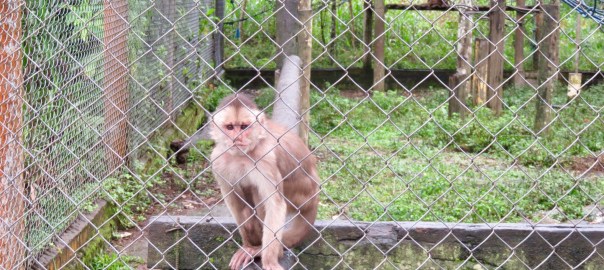
Plenty of monkeys, both inside and outside the fences.
This old guy looks like he may deliver Hamlet’s soliloquy
You lookin’ at me?
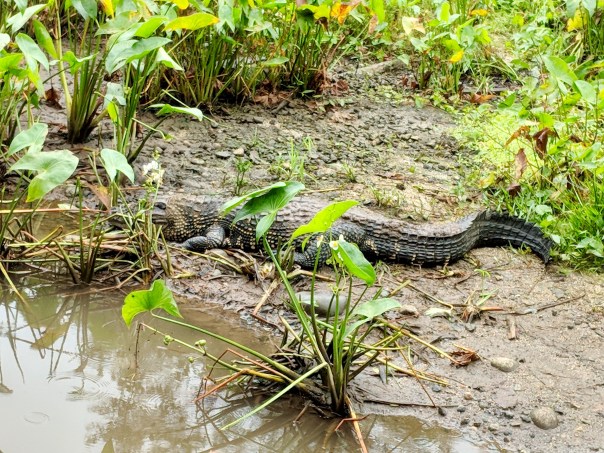
Coatimundi A caiman
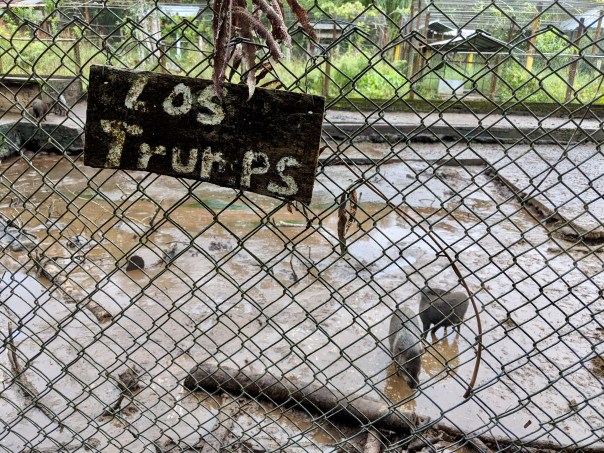
A bit of political commentary – the muddy pen of peccaries (pigs) was labeled ‘The Trumps’.
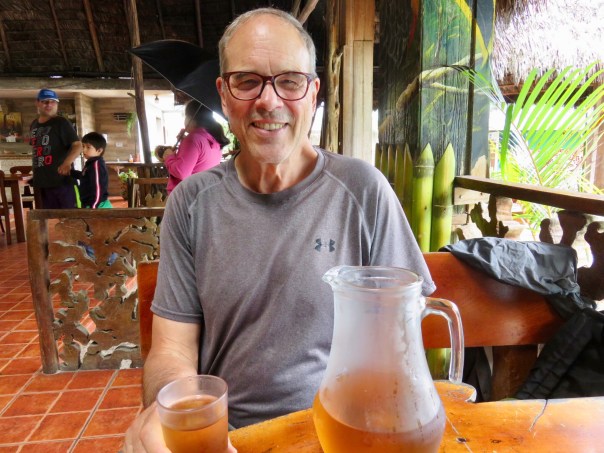
We enjoyed a pitcher of Wayusa tea at the refugio restaurant. Very sweet and caffeinated.
Remember I told you that the currency here is the U.S. dollar? Well, the smallest bill used here is the $5. If you pay with a five, you will receive $1 Sacagawea coins as change. Now you know where all the dollar coins went!
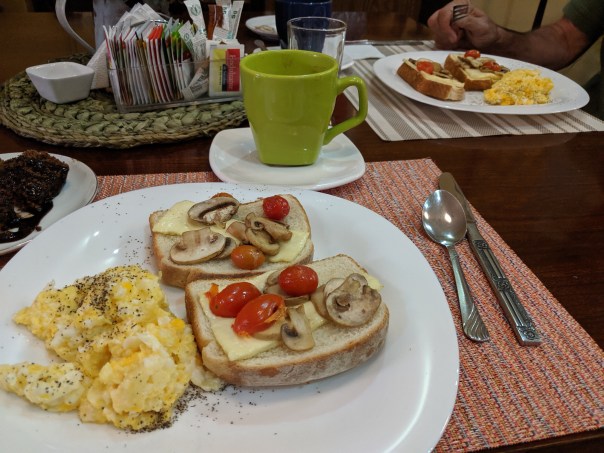
Jun 28 – After a good night’s sleep and a very good breakfast, we ventured out to find the Omaere botanical park, on the edge of town. And just like that, we’re back in the jungle!
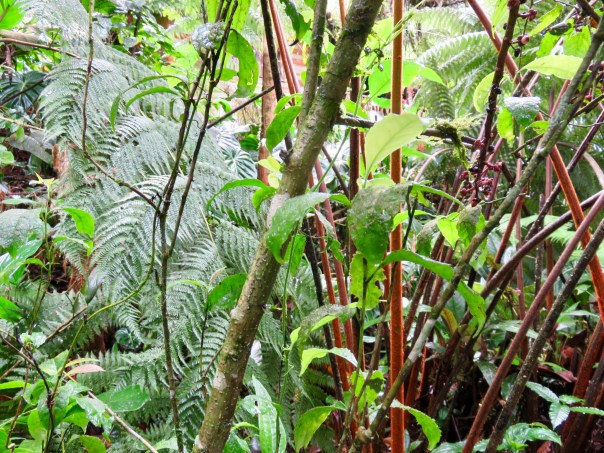
Omaere means ‘nature of the rainforest’ in the language of the native Waorani people. The park (once a cleared field used for grazing cows) was purchased by two French women and one Schuar indigenous woman almost 30 years ago, and planted with all the medicinal plants important to the nearby indigenous people. It now looks like the jungle it used to be, lush and green and teeming with life.
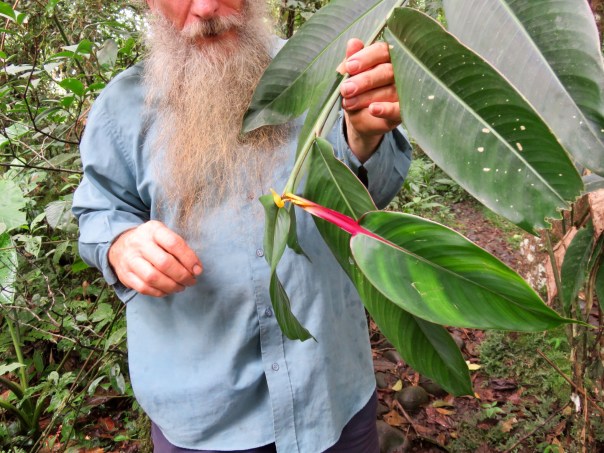
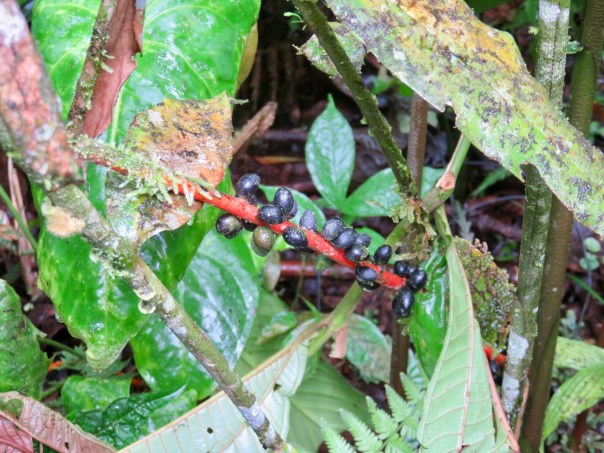
We met Chris, a biologist from California who came to Ecuador to complete his dissertation 30 years ago, and never went home. He provided a bilingual tour of the medicinal plants, telling us what each one was good for, and how each medicine was prepared.
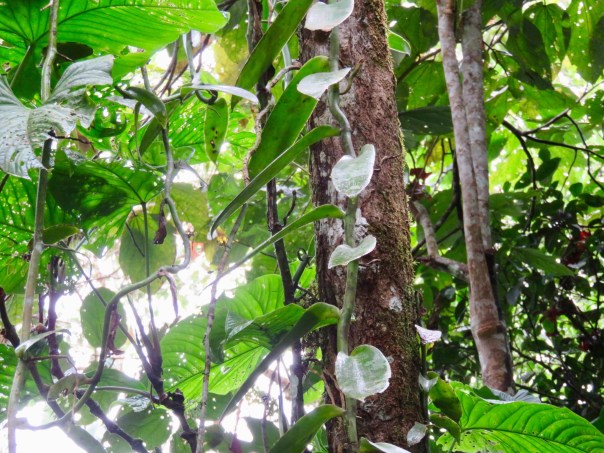
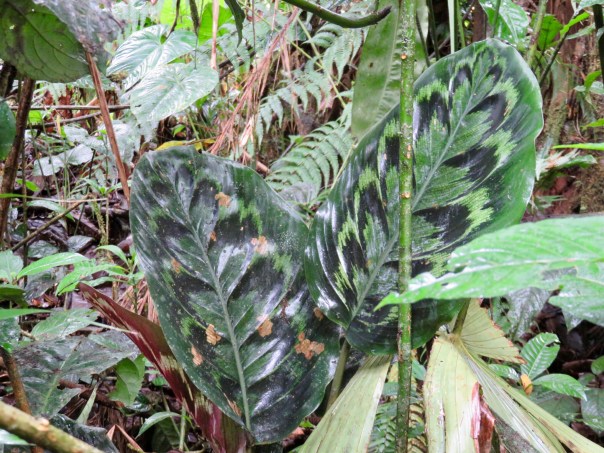
Vanilla vineBiggest prayer plant ever
Chris explained how the Schuar and Waorani people lived and hunted (with blowguns and curare darts), how a fierce hunter could have as many as 15 wives, and how they maintained an ecologically sustainable life over the centuries. He also had tinctures, shampoos and handicrafts to sell.
Chris expounded about the eco-friendly toilets he created for the park. Urine flows out a pipe right onto the forest floor to nourish the plants, and poop is covered with soil and stored until it turns to compost. We agreed that it makes no sense to use our precious fresh water resources to flush away our waste, but are not sure that folks back home will be willing to store their poop for a year…
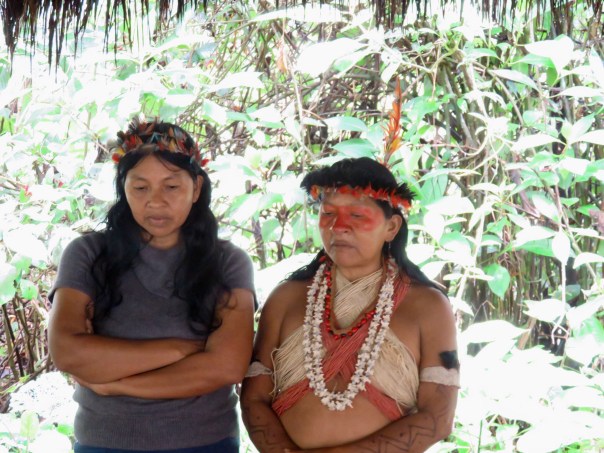
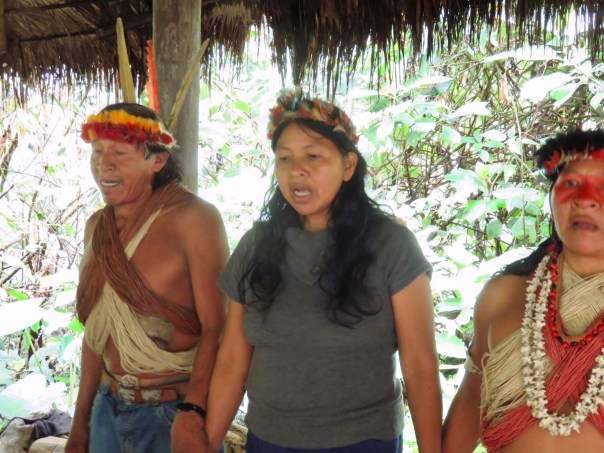
Then we were treated to a native cultural performance by a Waorani family – a man named Yeti, his wife Rosario and her sister. They offered to perform in their native costume – stark naked with a single string tied around the waist – but we figured that we could get the gist of their dance without their full disclosure, so they just wrapped themselves in ropes and put on headdresses.
They chanted several songs in a flat repetitive tone, and shuffled back and forth. Rosario offered to paint my face with the red mask that she wore, but I politely declined.
Chanting – no eye contact
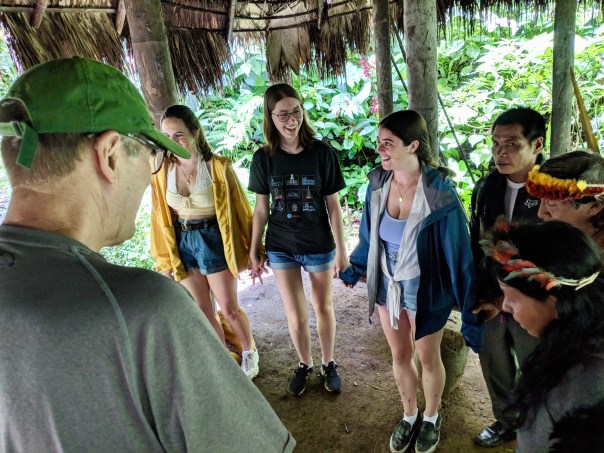
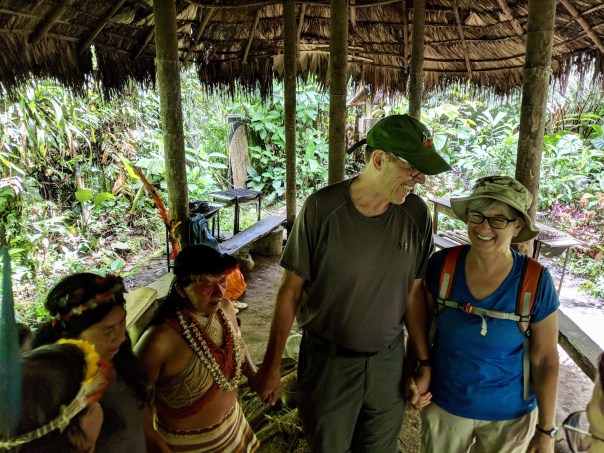
Then Yeti asked if anyone would like to get married. The college kids in our group all declined that offer, so Jim volunteered that we would get married in the Waorani way. We all got up and shuffle danced, then everyone gathered in a tight circle around us and chanted. And just like that, we were married (again!).
We walked out of the park to find some lunch and found ourselves in the tourist part of town. We were the only tourists in sight.
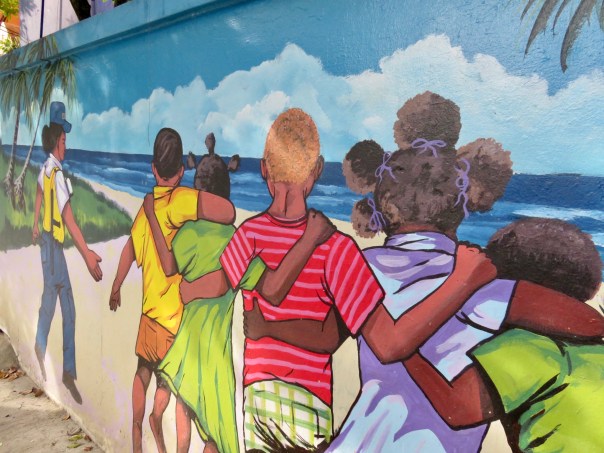
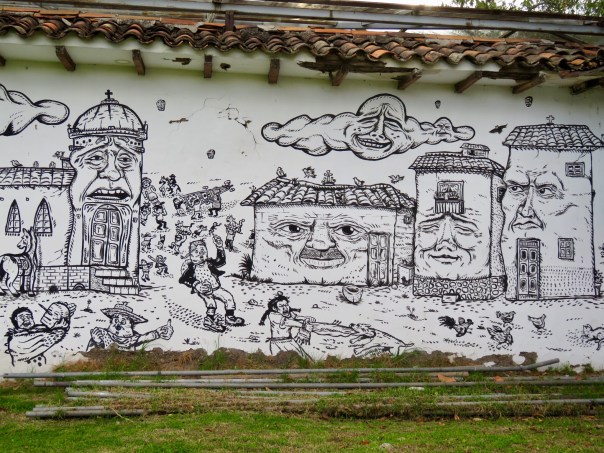
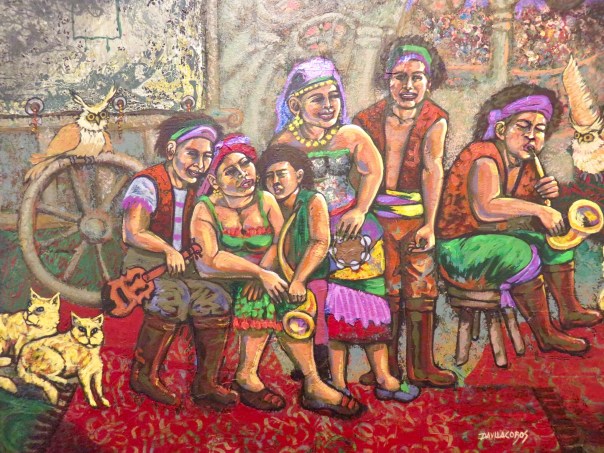
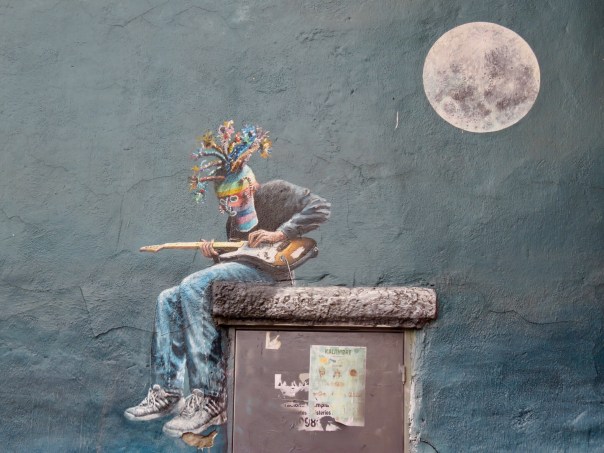
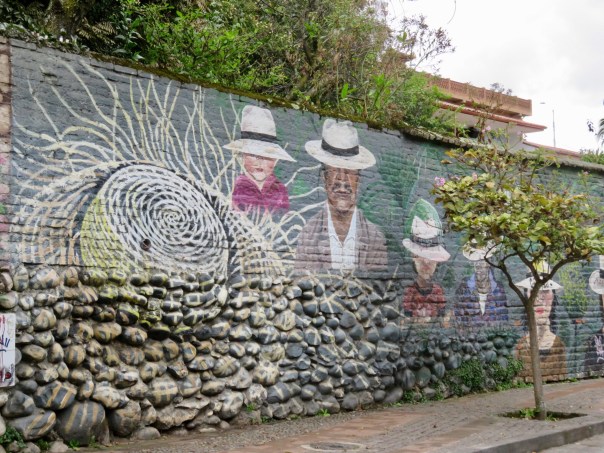
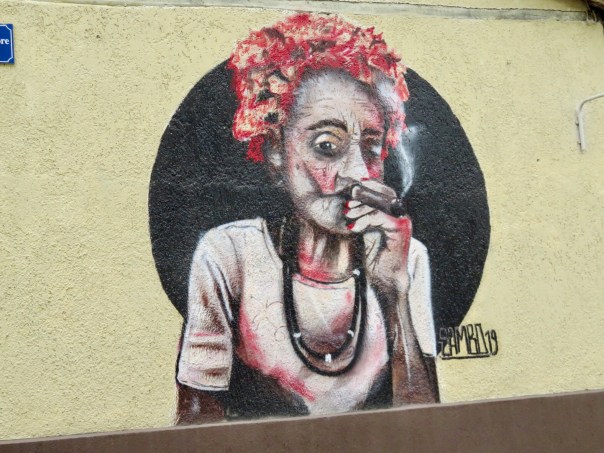
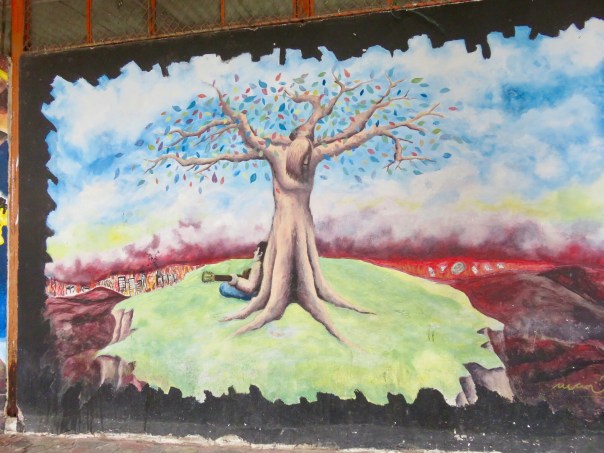
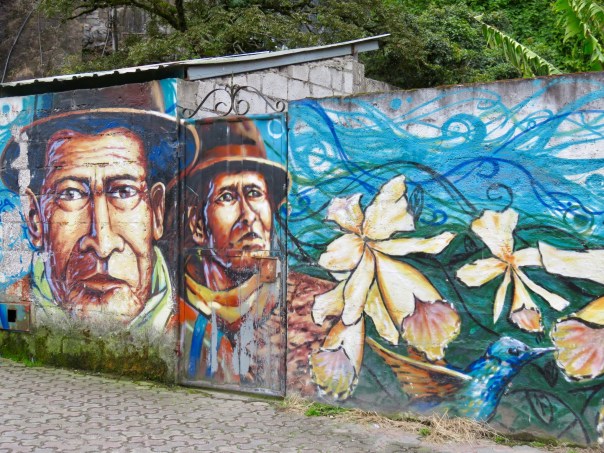
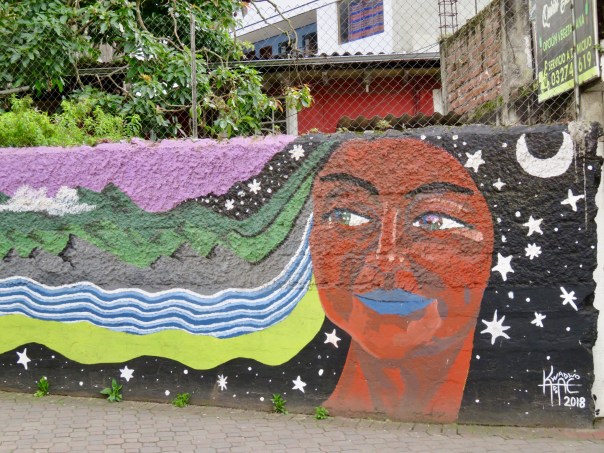
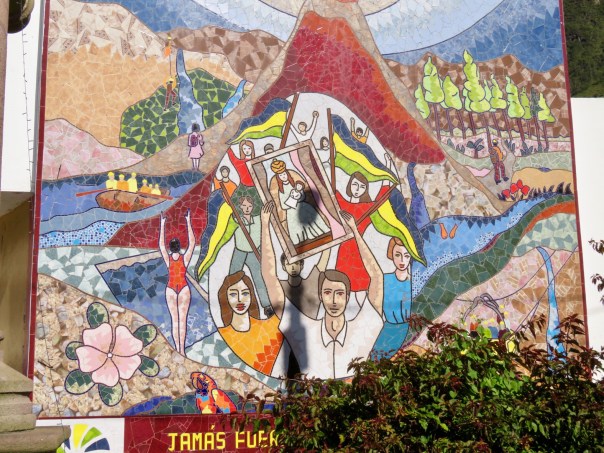
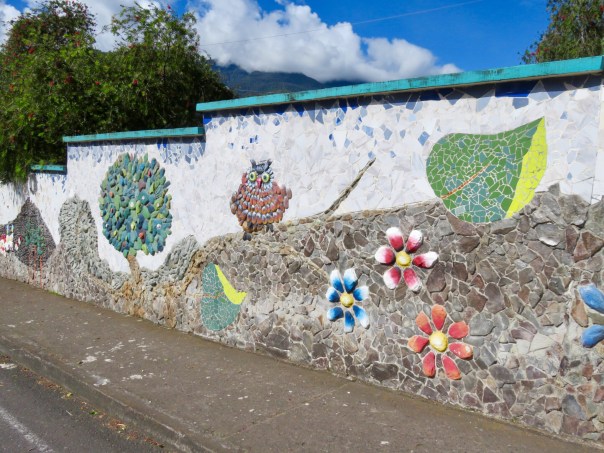
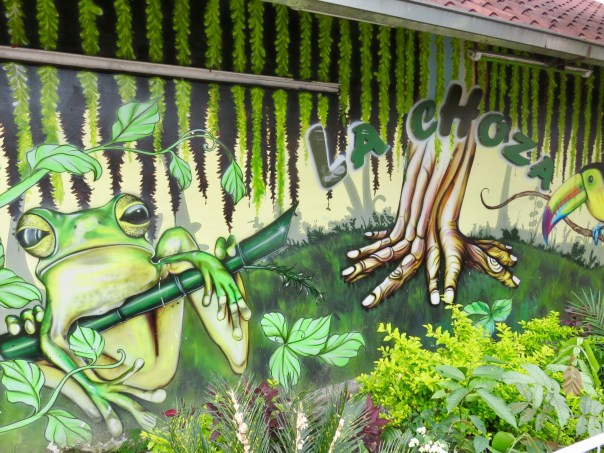
Wall art!
After a fine meal of pollo y papas (chicken and fries), we walked home. The roads are being torn up to put new pipes in. Unlike our experience in Guatemala, most all the roads we have encountered here are paved.
After a siesta, we went out for dinner and found that almost all the restaurants we had seen in the afternoon closed at 4pm. Dinner out isn’t really a thing here. Way down the street we found an Ecuadorian Chinese restaurant – not your typical fare, but not bad, considering.
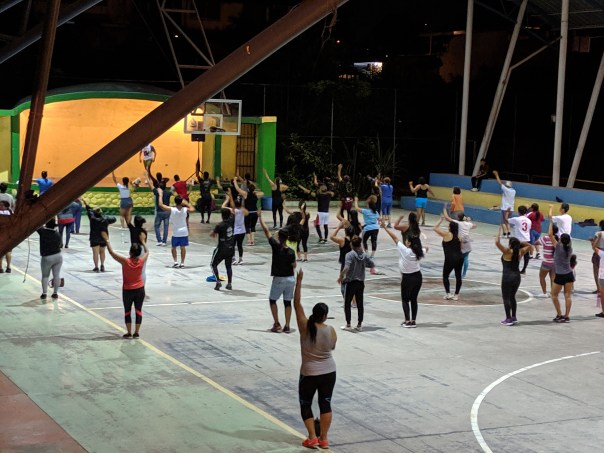
On our way home we heard music, and walked over to the sports stadium. There, under the lights, was the biggest community Zumba class ever! How fun!
An ad at the pharmacy – I’ll have what she’s having!
Jun 26 – So, life continues here in Iyarina. One morning we had no hot water, the next day no WiFi, then last night the electricity went out entirely. Small inconveniences when you consider how well we are living in the middle of the jungle!
Jim taught his last class yesterday, so our official duties are over. We continue to walk every day and find new things to appreciate. The sky has been very blue, with no rain for the past few days. Our clothes dried on the line! As we near the end of June, the rainy season is coming to an close.
Walking down the road, we encountered a maintenance crew cutting brush with machetes to keep the jungle from overtaking the road. Not sure if the dog is part of the crew.
A man told us that if we took a side road, we could climb up El Mirador – a scenic overlook. Of course we had to check it out. As soon as we started walking up, we were joined by Flora, a barefoot nine year old with a lot to say.
She took a liking to Jim, and kept up a stream of chatter as we ascended the hill.
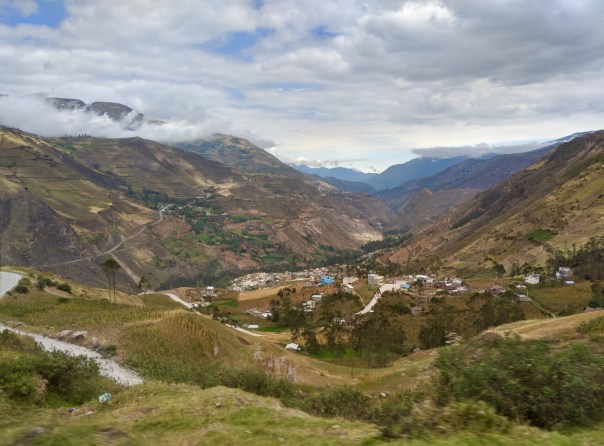
The view from the top.
We walked back to the house of the shaman, and spoke with his wife Maria. She showed us the herbs she grows, and told us which ones are good for back pain, and which help if you have an open wound.
More wildlife.
Don’t hug this tree!
There are many little huts erected at the roadside. Bus shelters? This one is also a shop. There was not much on offer, mainly warm bottles of Big cola.
Some beans set out on the pavement to dry.
Pretty fungi.
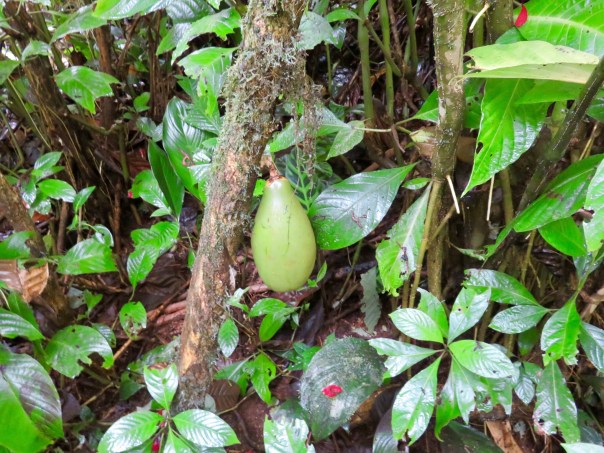
Papaya, I thinkPineapples growing on the ground – I always thought they grew on treesHuge heart shaped leaves – so pretty
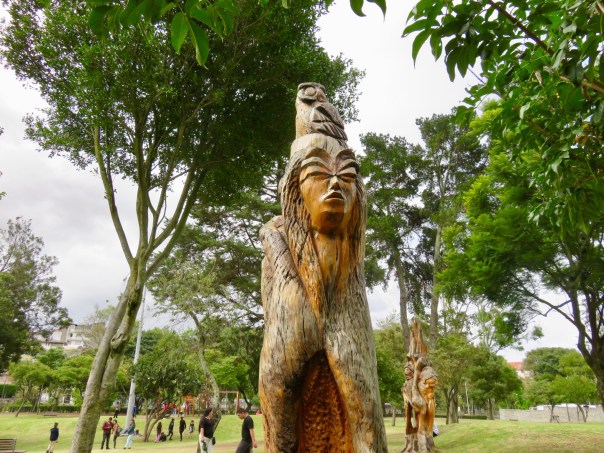
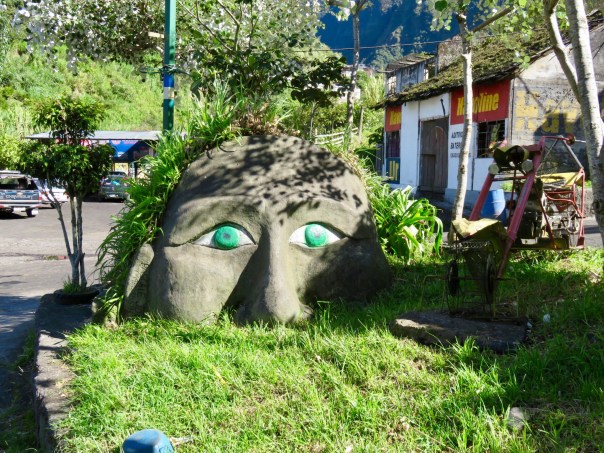
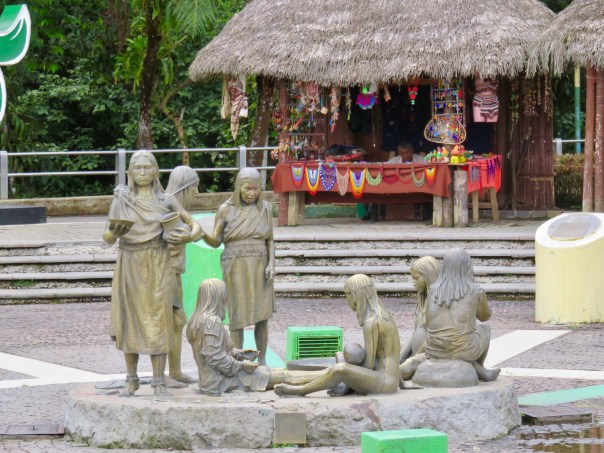
More student sculptures – water women (mermaids) are a thing here.
Jun 27 – After one last delicious breakfast, we bade farewell to Iyarina. Janis had hired a cab to take her back to the airport in Quito, and because the bridge is still out due to last week’s floods, she has to take the long detour, which goes past our next stop, Puyo. She graciously offered to let us share her taxi. Luisa also came along, as she actually lives in Puyo.
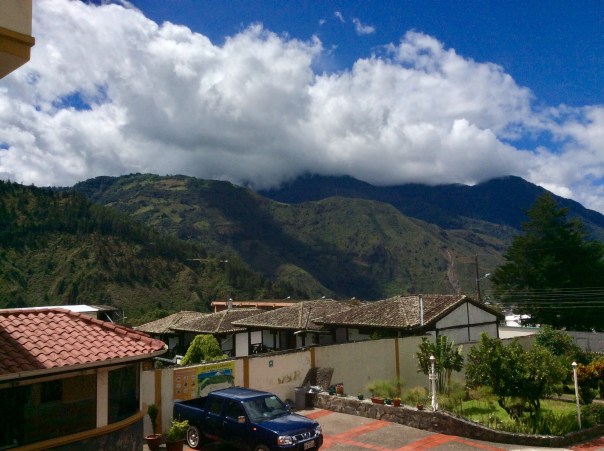
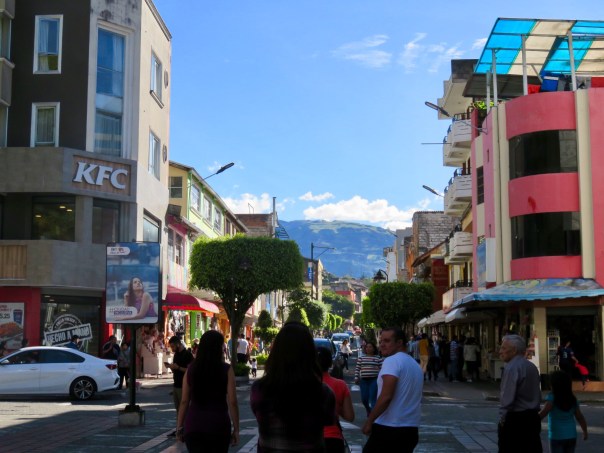
An hour and a half later, the jungle is gone, and we are in Puyo.Our very nice hotel is right on the main street, which is full of little shops and eateries. We will be here three nights, which should give us more than enough time to see what Puyo has to offer. This is not a tourist town, so we will see. Stay tuned!
Jun 22 – Today we accompanied Janis and Luisa on a six mile trip by taxi to the nearby indigenous community of Shiripuno and the town of Misahualli.
Shiripuno serves as a traveler’s hostel with the hope of attracting tourists. It is run by a women’s cooperative. Right on the Rio Napo, some of their crops were damaged by yesterday’s floods.
PlantainCoconut
The women demonstrated how to crush manioc, a root vegetable that can be cooked as a sort of bread. It is mixed with wayusa tea, wrapped in sweet leaf and roasted in the fire.
In another recipe, the manioc is chewed by all the women, then spit back into a communal bowl where it ferments for several days or weeks, then used as an intoxicant. We were offered some wayusa.
We were shown a huge rock that is said to be spiritually powerful. In the rock you can see a face and a tapir.
See the face?See the tapir?
The women drummed and danced for us. Janis said the blue outfits, beads and grass skirts are a recent addition to attract tourists, but the dance is authentic, characterized by the swinging of their long hair. Grass skirts may have been used in pre-Colombian times.
There was a three year old just learning the dance, who was having a very good time doing her own thing. So cute!
Then we ventured into Misahualli. Here they imported some monkeys in the hopes of attracting tourists. There’s a monkey statue in the square.
Luisa, Janis, Luisa’s sister Eludia and Jim
The town’s primary attraction is canoe rides down the churning Napo River.
Grilled grubs are a delicacy here. Live grubs are skewered, then grilled, still wriggling.
After a few minutes, they are ready to serve. Jim pronounced them juicy and tasty!
The capuchin monkeys entertained the visitors, very active for mid-afternoon.
Misahualli is a very poor town, with an interesting variety of tourist shops and expats.
Jim and I would have explored more thoroughly, but Luisa at 90 could not walk far, so before too long we took a taxi back to Iyarina. An interesting day.
Jun 20 – So, I haven’t really talked about the weather here. It is not hot at all considering our proximity to the equator, perhaps in the low 70s during the day, but very humid. Pleasant walking weather. After sundown it gets chilly enough for a sweatshirt and long pants. The river provides a constant background noise as it roils along, soothing white noise. We are sleeping very well here.
Morning mist on the hills
More pretty flora.
Jim is busy teaching the anthropology students about Asian shamanism, to enable them to compare it to the Quechua shamans here. He also gave a hypnosis demonstration so the students could better understand the trance state. Here is the open-air classroom where most classes are held. I enjoy the contrast of the thatched roof and the flat screen tv.
Tod, who owns Iyarina, is the son of American doctors who brought him to Ecuador as a small child; he was raised here and married into an indigenous family. He maintains an academic career at Arizona State, while concurrently running this center.His extended family works here in all capacities. He explained (and I oversimplify) that in the Quechua culture, a person’s sense of self includes his entire family, and not caring for family members is thought to result in illness or misfortune to the children or elders of the family. A big responsibility.
The Quechua derive their power from the mountains that surround them, and, in times past, sacrificed animals or children to keep the mountains happy. In a land of many volcanoes, you can understand how this belief would arise. If a person experiences illness or misfortune, shamans are still consulted to determine the source and remove the misfortune.
We went with the anthropology students to observe a shaman ritual.
The shaman, named Bartolo, drank a cup of the hallucinogen ayahuasca, then chanted to various animal spirits. His wife Maria sat behind him. The round stone in front of him has magical properties and was described as female. He encouraged the students to touch the stone and the section of ayahuasca vine.
There were two smaller dark rocks described as male, that looked like faces. They served as protectors.
The shaman had a hand rolled tobacco cigar that he used to blow smoke over all the objects to cleanse them. The bunch of leaves were shaken throughout the ceremony and used to brush away negative effects. The shaman’s chant was calming and beautiful. Quite an experience!
Jun 21 – It rained so heavily through the night that the sandbar we could previously see in the river was submerged. Charles and his daughters are leaving today to travel home to Utah, and he received word mid-morning that the bridge back to Tena was washed out, and they would have to take a long detour. Safe travels home, Charles!
Jun 18 – So, the first thing you should know about the Amazon jungle is that the WiFi isn’t great, so my posts will be less frequent. But isn’t it amazing that we have WiFi at all?
Inchplant, growing wild
The second thing is that so far this place is really wet, all the time. It is the rainy season, and it rains in the afternoon, and sort of mists on you even when the sun is out. It rains at night. Towels don’t dry. Clothes mold on the line. Everything is sort of musty. This isn’t such a problem for the professors and students who arrived with fat suitcases full of clothes. But for us poor backpackers with only two outfits (one to wear and one to wash), these two weeks will be a challenge!
There are about 50 students here, mostly post grad, pursuing different courses of study in anthropology, linguistics, biology, sociology, pre-med, and I’m sure other disciplines that I haven’t encountered yet. The ones I’ve spoken to so far hail from Pittsburgh, Arizona, Utah, England, and Washington state. They are mostly here on government FLAS (Foreign Language and Area Studies) grants of $5000. per student for a seven week semester. They are an affable bunch, mostly female, happy to spend time talking with a non-academic like me.
We eat communally in an open-air dining area, with food prepared by native cooks. Lots of fruits and fruit juices, fried plantain, dough fritters, rice, beans and manioc. The main meal is served midday, with a light supper in the evening. Burrito night is the favorite meal, and banana covered in chocolate is the favorite dessert, according to the students.
Janis introduced us to the strong woman of the local Quechua village, Luisa.
Janis and Luisa
She says she is 90 years old, and still labors with her sisters and daughters. She patiently answers student questions about nuances of the Quechua language, and tells them the stories of her people.
Other Quechua women run a pottery class, exposing the students to ancient pottery techniques. The pots are dried on the cooking fire, then glazed and decorated with vegetable extracts. They are very fragile.
Jun 19 – Tod, the owner of Iyarina Lodge, showed us where to pick up a trail through the jungle. It is the trail his family used before the road was improved. The trail is sopping wet and muddy. There are beautiful blue morpho butterflies here. This is a small one resting on a wall.
On the trail we spied a pair of large ones, bright electric blue, each wing as big as your hand. Their underside is brown to blend with the tree bark.
Try as I might, I couldn’t capture the large morphos in flight with their wings open. Here’s a pic from Google to give you an idea. They are breathtaking.
These are tiny spiders that build communal webs, which the students tell us is unusual.
Lots of cieba trees, huge ferns and flowers.
Near the road are some lava formations, although there are no volcanos nearby.
Wall art!
Let’s see if I can post this. Stay tuned for more!
Jun 16 – It rained all night and into the morning, reminding us that we are indeed in a rain forest. Here are some more of the beautiful plants growing all around us.
At mid morning, Jim’s colleague Charles and his wife Janis picked us up and drove us out to Iyarina Lodge, an educational compound about half an hour from Tena. Iyarina is in the Amazon jungle, right on the Rio Napo. Charles and Janice are both professors at Brigham Young University in Utah, and have been coming here every summer since the 1980s to study the Quechua people who live here. Janis is the authority on their language and Charles is a cultural anthropologist.
The center hosts college and post doc students studying linguistics, anthropology, and biology. It seems that some very interesting spiders 🕷 and frogs 🐸 live here. We have a beautiful big room overlooking the river. Here is our view.
Here is our bathroom!
There are hiking trails and lava formations, and perhaps a trip to a local village nearby. Jim will present some sociology and shamanism to the students. It should be an interesting two weeks.
Jun 15 – We set the alarm for 5am, but of course we didn’t need it, as we woke up every hour throughout the night to check the time. Are we the only ones who do this? The 15-passenger van arrived at 5:15 to take us to the next chapter of our Ecuadorian adventure – Tena. The van picked up passengers at various spots around the city until all the seats were full.
It was still dark for the first part of our ride, but the popping in our ears let us know we were coming down from Quito’s high elevation. Then we had to remove our jackets as the weather warmed up. We saw some breathtaking views of the Andes covered in morning mist, but the condensation on the windows didn’t allow for any photos. Use your imagination!
By 9:30 we arrived in Tena, and the van stopped right at our hotel. Just like that, we’re back in the jungle!
Tena is a scruffy little town, touted as the cinnamon (canela) and wayusa capital of the world. Wayusa is a leaf that is dried and used as a caffeinated tea, drunk by indigenous people as an aid to having visions. Located on the Pano River, Tena caters to adventure tourists who come here to whitewater raft, kayak and take jungle tours to interact with the indigenous Quechua people and partake in shaman rituals. We are here for just a day, prior to meeting up with Jim’s professor colleague tomorrow.
Tena is also home to Parque Amazonico La Isla del Amor, a nature park right next to our hotel. We dropped off our bags and walked over to check it out.
What’s the first thing we saw? An observation tower! “Up!” said Jim, so up we went.
As we walked along, I was just starting to ask Jim what our chances were of actually seeing any wildlife, when out of the brush strolled a tapir, big as life and unrestrained in any way!
Jim moved in, in pursuit of a Facebook video, causing me to wonder how close was too close to an animal this size, even if they are herbivores. Say cheese!
Five minutes later, we met another one!
This day was already a home run as far as I was concerned. Further down the path, there was a restroom (read tin-roofed outhouse), and I decided to answer a call of nature. As I sat, I heard a loud crash right above my head, and Jim informed me that a monkey had just jumped onto the tin roof! I looked up, and there was a sweet-faced little spider monkey, looking down at me inquisitively through a gap in the tin. I’m sure you’d like to see a picture of this, but I was a little busy at that moment.
I rushed out, got my camera and snapped a few shots of the little guys right above my head. Don’t you just love that sweet little face?
After a while, the wooden boardwalk stopped abruptly and only the cement supports remained. Jim said this was a town once enriched by oil wealth, but when the current administration came into power, this park project was just never finished. The oil wealth is now used to pay back the loans for infrastructure made by China, and there’s no money left over. Jim was happy to walk on the support beam, but my balance isn’t that good, so we turned around.
Here is a ceibo tree, where elves and fairies – the guardians of the forest – were thought to live.
I love seeing what we consider ‘house plants’ growing huge and free in the forest.
In the evening we strolled the town board walk in search of supper. Here’s some wall art:
Jun 14 – Today is our last day in the city, so we went back to Centro Historico to see more of the sights.
Touch the hand of San Augustine for a blessing:
Here are a few examples of wall art, which I look for wherever we go:
We checked out the Art Museum, which displayed paintings from classic to modern:
In the Plaza de San Francisco, we got caught in a flurry of pigeons:
The Mercado was small, but had plants used for botanical cures:
…and some jumbo sized pigs feet:
…as well as normal market fare:
These eggs were our supper.If you ask for a chicken leg, you get the foot too!
Iglesia La Merced (Church of Mercy) was the prettiest church of all:
It had scenes painted on glass around the doorway that depicted the coming of the Spaniards and conversion of the native Ecuadorians.
It also had many paintings of regular people being watched over by the Madonna.
The Museo de la Ciudad (Museum of the City) showed the history of Quito using mannequins and dioramas:
It all started in the jungle…
The museum building was once a hospital.Battling the Spaniards in the jungle.Semana Santa – Holy Week processionTraditional costumes in different areas of EcuadorMe hanging with some native ladies
Thank you Quito (and the Virgin on the hill) – we had a blast! Tomorrow we’re off to Tena!
Jun 13 – Today we ventured into the Centro Historico, or historical part of the city. Around the main plaza are the Presidential Palace and official buildings.
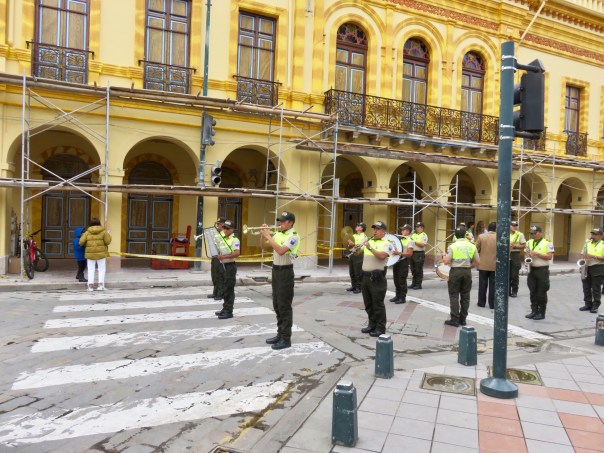
We heard the municipal band play some snappy marches:
…and admired the talents of some street buskers:
This guy was the best. His puppet dancing partner was attached to his hands and feet, and he really made her shimmy!
Of course, there were plenty of churches, displaying all the gold and art that were not in evidence at the Basilica yesterday.
Adoration of the Magi
Jesus presented at the temple
My favorite painting showed Jesus literally sending a message to Saul at Damascus – too bad Saul was blind and couldn’t read it!
Saul, Saul why do you persecute me?
Many of the churches were museums, with no worshipers in evidence, but one active church, El Sagrario, suffered from loose floorboards, and every step sounded like a herd of buffalo stampeding by. I felt sorry for those trying to pray in such a noisy space!
We admired an exhibit of small Salvador Dali sketches:
We visited a monastery and learned the story of Santa Mariana de Jesús, who was the first-ever Ecuadorian saint. She sacrificed herself to save Quito during a plague in the 1600s (could not find an explanation on how her dying saved the city from germs…)
Unusual to see wooden cloisters instead of stone
We ate an excellent lunch – hot, freshly cooked, and served with delicious cantaloupe juice to drink! Before we knew it, we had walked all the way across town to behold the Virgin Of El Panecillo, the largest aluminum statue of Mary in the world, and the only one with wings.
Most tourists are content to admire the statue from the foot of the hill, but you know Jim wasn’t having any of that. If there are steps to be climbed…
The Virgin up close in her winged glory, standing on a snake.
When we finally reached the pedestal, we could see there was a chapel inside. We stepped in, only to be offered the opportunity to climb up to an even higher viewing balcony at the statue’s feet, for only one dollar. Hah! I told Jim they’d have to pay ME to climb any more steps, and it would definitely take more than a dollar! Of course, Jim went up. I waved. Can you see him?
Then it was time for the much easier walk down, followed by a congratulatory soft swirl ice cream cone. If you are interested, my step counter registered 15,072 today!